


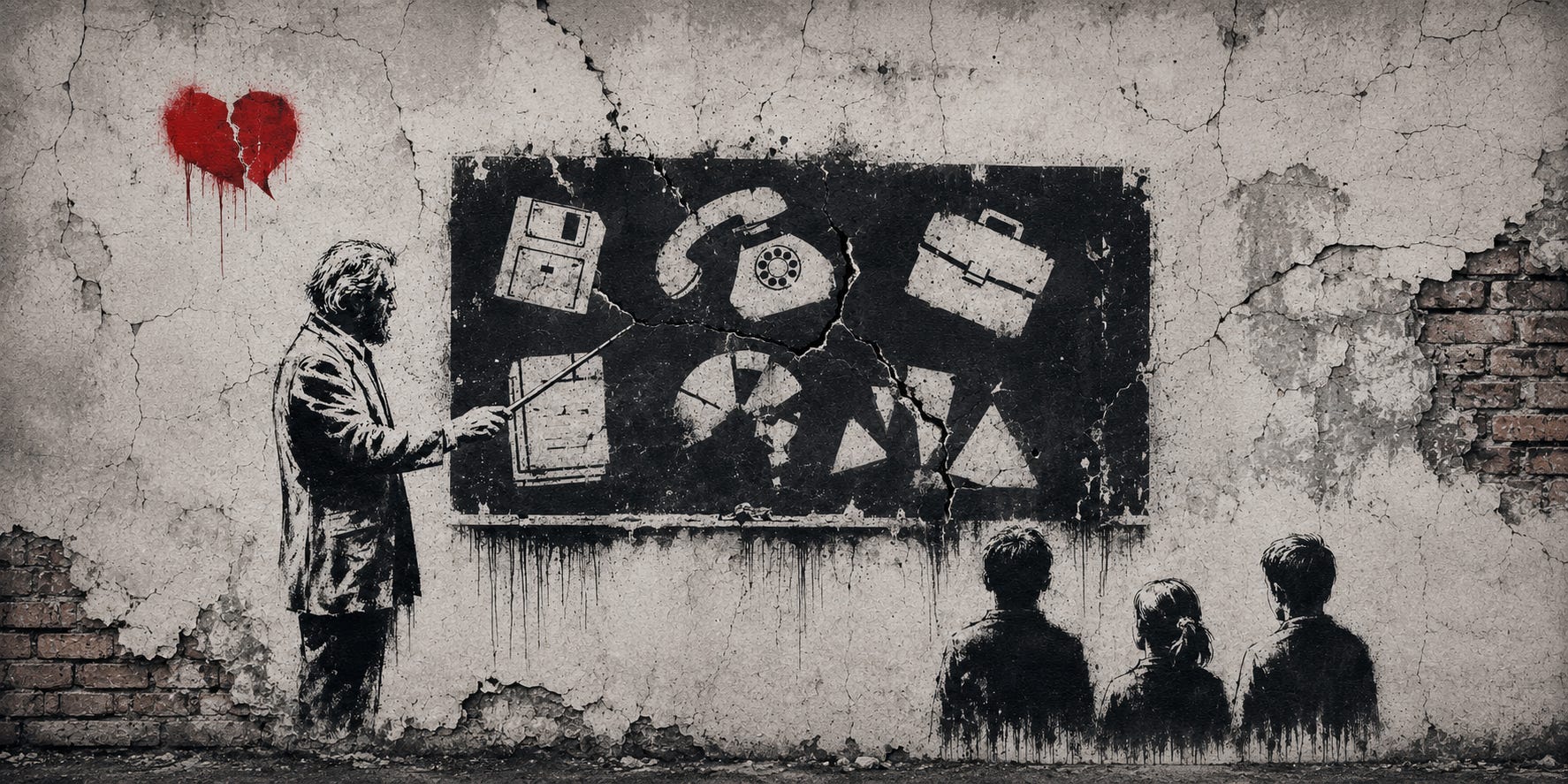
I had to Google the word “SEO” ten times before I understood it.
This was 2008. I was fifty-one. Something was forming on the internet and it had grown its own language before most people noticed it existed.
Search engine optimisation. Content marketing. Personal branding. Social media marketing. Foreign words. New words. Nobody was fluent, including the people using them.
So I did the only thing I knew how to do. I took notes in public.
Short posts. Tweets, Observations.
Whatever caught my eye. I was not teaching anyone. I was trying to work out what was happening, and writing was how I thought.
Fourteen years and thirty-three million readers later, I had a media company built on top of that language.
Every word of it is now obsolete.
Not wrong. Obsolete. The habits still fire, the keyword in the headline, the publishing schedule, the impressions checked before breakfast — but the machine they were feeding has been switched off underneath them.
And here is the part that keeps me awake.
I did not just learn that language. I taught it.
The villain is not a technology. It is a deal.
Everyone wants to point at AI. That is the easy answer and it is the wrong one.
AI is the third repossession.
In 2012 I had a Facebook page that reached the people who had chosen to follow it. Then organic reach was throttled, and reaching my own audience started costing money. That was the first.
Then Google began answering the question on the results page. The snippet took the answer. The click stayed home. That was the second.
Now the answer engine takes it entirely. That is the third.
Three separate events. Fifteen years. One identical arrangement underneath all of them.
You build the audience. Someone else owns the road.
That is the villain. Not a technology but a deal. And we have signed it three times, each time convinced the new road was different from the last one.
“AI broke my business” is a complaint.
“I rented my audience three times and was evicted three times” is a confession. And it is the true one.
What the third eviction looks like
The Pew Research Center watched 900 people run 68,879 Google searches. When Google placed an AI summary at the top of the page, 8% clicked through to a website. Without a summary, 15% did. Links inside the summary itself were clicked one time in a hundred.
SparkToro then measured the whole market with Similarweb’s panel. In the first four months of 2026, 68% of US Google searches ended without a click to anywhere. Not to a website. Not to an ad. Not even to one of Google’s own pages.
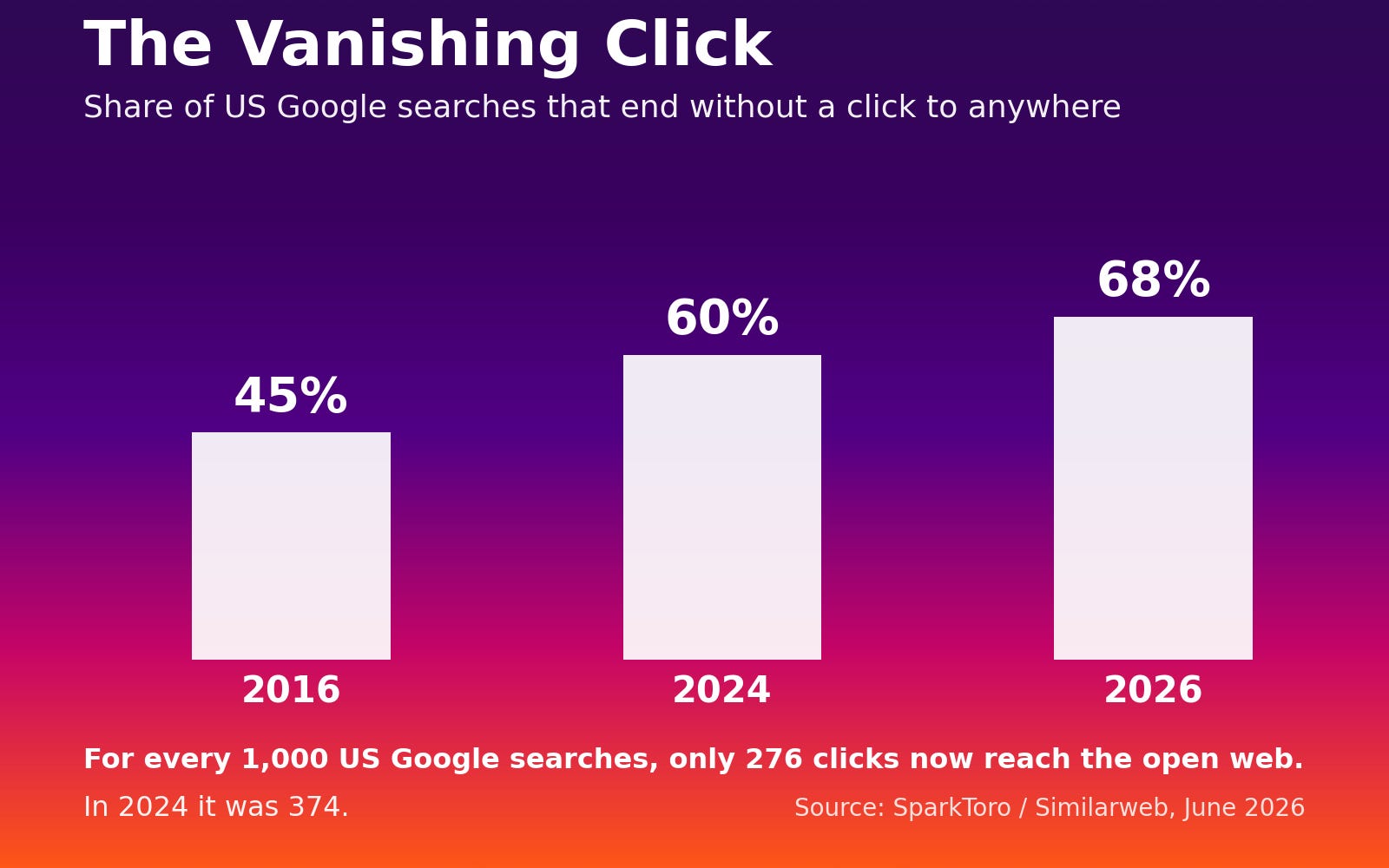
Chart: The Vanishing Click. Source: SparkToro / Similarweb, June 2026
Ten years ago that figure was around 45%.
Here is the version that hurts. For every 1,000 searches, 276 clicks now reach the open web. Two years ago it was 374.
And it is not evenly spread. Ten major tech and media sites saw their combined US Google traffic fall from 112 million monthly visits to under 50 million. Digital Trends went from 8.5 million clicks a month to 264,861. A fall of 97%.
The first thing that broke was the answer
I have written hundreds of posts called “The Ultimate Guide To Something.” For years they worked. They paid the mortgage.
Now look at the largest answer library human beings ever built.
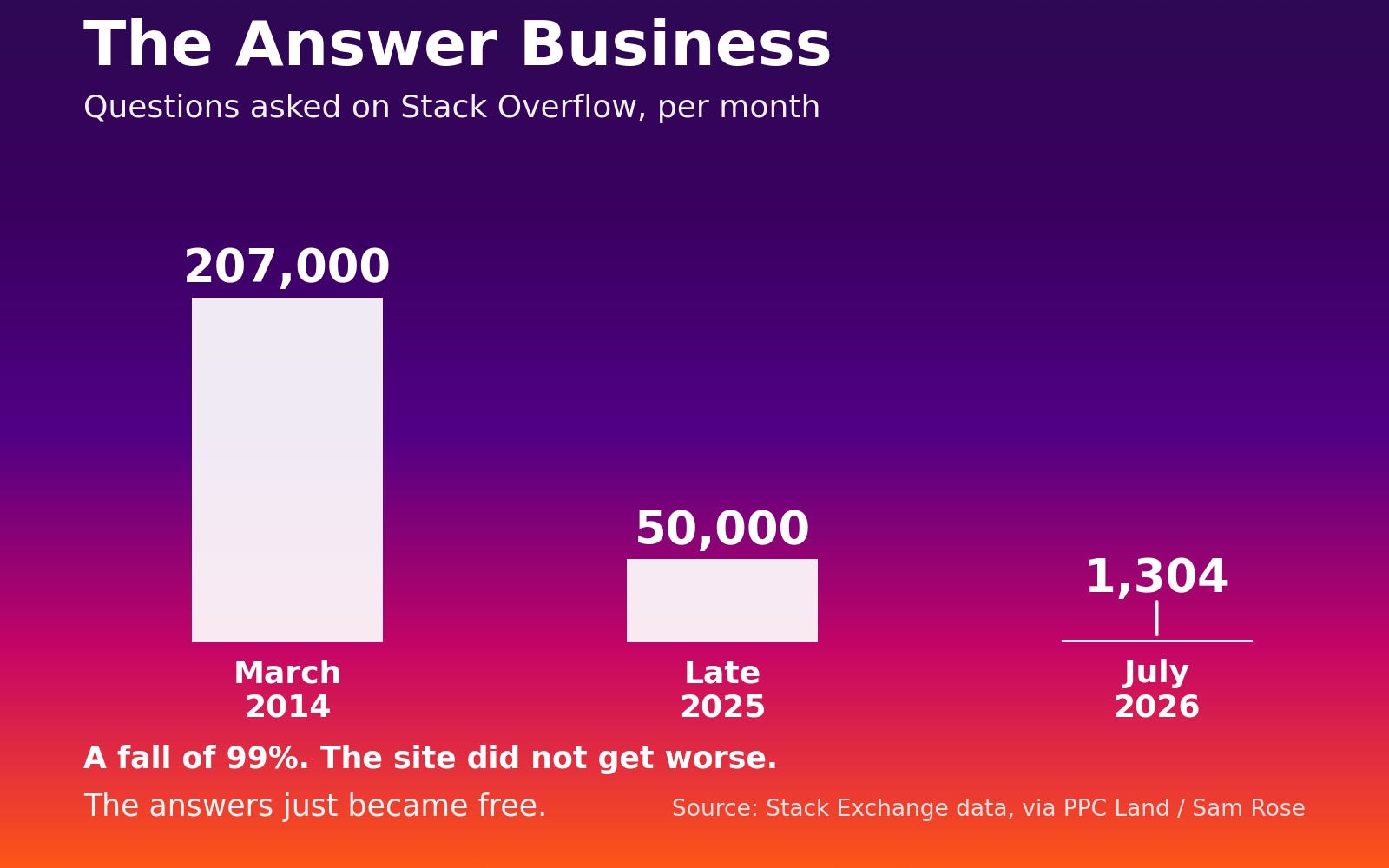
Chart: The Answer Business. Source: Stack Exchange data, via PPC Land
Chegg sold homework answers by subscription. Its share price fell 99% over five years.
Same disease. Both were in the business of storing answers somewhere they could be found.
If the value was the answer, it is gone.
If the value was the person who had to live through something to know it, it is not.
Machines hand out answers. They cannot hand out scars.
The second thing was volume
Publish more, get found more. It was the only strategy anyone offered for fifteen years. I taught that too.
Graphite sampled tens of thousands of pages from the open web. Machine-written articles now make up more than half of everything newly published.
Now the part almost nobody quotes, from the same researchers.
Those machine-written articles largely do not appear in Google results or ChatGPT answers at all.
Infinite supply. No visibility.
We flooded the world with words that nothing will ever read.
The third thing was proof
You sent forty applications and heard nothing back. You assume something is wrong with you.
LinkedIn now takes around 11,000 job applications every minute, 45% more than a year earlier. That is not more people wanting work. It is the same people, with AI firing off hundreds while they sleep. The average opening now draws 242 applications.
And 19% of organisations using AI to screen candidates have confirmed the software rejected people who were qualified. Not suspected. Confirmed.
Two machines are holding a conversation about your life and neither of them has met you.
Google and Cisco have started interviewing in person again. In 2026, the most reliable way to prove you are a human being is to stand in a room beside another one.
The sentence I did not want to write
Harvard, Imperial College London and the German Institute for Economic Research went through two million freelance job posts across 61 countries. Within eight months of ChatGPT arriving, demand for freelance writing fell 30%. The steepest fall of any category they measured.
Then Washington University tracked 92,547 writers and found the pattern that should stop all of us. The best paid and highest rated were hit hardest.
Quality was never the moat. It was just expensive to copy.
Now let me argue against myself
I have staked a lot on the idea that the human signal is what survives. That makes me exactly the man most likely to see collapse everywhere and call it proof. So here is the case against my own article.
The flood had a ceiling. In 2022, Europol predicted 90% of online content would be machine-made by 2026. It reached 50.9%, stopped, and drifted back to 49.9%. People kept writing.
Traffic moved more than it vanished. Chartbeat’s network of more than 2,500 publishers lost 34% of its Google search traffic in a year, but total pageviews fell only about 6%.
Some names went up. In the same period, the Guardian and the BBC gained. They did not out-optimise anyone. People typed their name.
The money did not leave. Fiverr lost buyers last year while spend per buyer rose 8.3%. Fewer clients. Bigger cheques.
None of that says nothing broke. It says something more precise, and far more useful.
It is not a collapse. It is a barbell.
At one end, anything cheap and generic went free.
At the other end, anything rare and named got more expensive.
The middle fell out.
And the middle is where almost all of us built our careers. Good enough. Reliable. Competitive on price. Findable.
Upwork writing projects dropped 32% in a year while specialists went the other way. Finance writers averaging around $73,000. Some fintech work paying 95 cents a word.
Same market. Two directions. Look down at your feet and work out which end you are standing on.
Everyone is making the 2009 bet again
Here is what worries me most, and almost nobody is saying it.
Watch what people are doing right now. Learning GEO. AEO. Answer engine optimisation. Rushing to master a fresh set of acronyms in exactly the way I mastered the old ones.
I got fifteen years of return on learning SEO. The vocabulary and its tactics that worked held long enough to build a company on.
Nobody gets fifteen years now.
It is more like two years.
The half-life of a platform tactic is under two years and shortening. Anyone going deep on the new language is buying a skill that expires before it compounds.
So the adaptation is not learning the new vocabulary.
It is learning it shallowly, on purpose.
Rent the tactics. Own the thing underneath.
Then….
Test and experiment ad iterate at high velocity
What survived was the method, not the output
Look at what I actually did in 2008. I did not learn SEO. I noticed a change before it had a name, wrote my way into understanding it in public, and became the person who could explain it.
The output died. The method did not.
It is the only thing that has survived all three evictions, and the only thing that was ever mine.
Four moves follow from that. All testable this month.
Publish only what cannot be regenerated - Primary observation. First-party data. What happened to you last Tuesday. If a machine could produce it from the public record, you have not written anything. You have filled a slot in a system that no longer pays.
Replace impressions with a name count - Branded search. Direct traffic. People who arrived because they were looking for you specifically. It is a far smaller number and it is the only honest one you have.
Sell judgment, not output - Output is now priced at machine cost, which is zero. Judgment is what you do with output, and it stays scarce because it takes a life to build.
Shorten the road to zero intermediaries - One list. One room. One group of people who would notice if you stopped. Not as insurance. As the primary asset. Everything else is rented, and you already know how that ends.
This is the work I am doing now. Zyrro starts with who you are rather than what you produce, because identity is the one thing on this list that did not get cheaper. If the four moves above are the practice, that is the place I am building to do them in. zyrro.ai
The verdict
Nothing on the broken list was ever the real asset. Rankings, volume, credentials, follower counts. Every one of them was a machine for proving something about a person, built in an age when proof was expensive.
Proof is free now. It is worth what free things are worth. What is left is the person. Not the summary of the person. Not the profile. Not the searchable record of what they once did.
The one who had to live something in order to know it.
The curse is that we will probably do it again. There is a new road being built and it looks nothing like the last three, which is precisely what we said the last three times.
The opportunity is that for the first time in twenty years, the cost of not renting has fallen to almost nothing.
I had to Google “SEO” ten times before I understood it.
I am not going to spend the next fifteen years learning a language somebody else owns.
Two things, if this landed.
Reply and tell me which of the four moves you are testing this month. I read every one of them.
And if you would rather work on the thing underneath than the tactics on top, that is what I am building at zyrro.ai.