



I have reinvented myself three times. I have never once taken a leap of faith.
I have observed what energises me and seen the patterns and chosen what my curiosity has demanded. It is an experiment of testing and watching to see what it reveals but also coupled with intuition to help me choose.
So…I’m building a company called Zyrro on exactly this pattern and more on that at the end. First, the three times it happened to me.
The story we are sold about changing your life has one shape. You are trapped. You wake up one morning, quit, burn the boats, and walk into the unknown with nothing but belief.
It makes a good film. It has ruined a lot of lives.
Here is what actually happened to me, three times, over forty years.
The staff room
I was 23 when I started teaching at a private high school in Melbourne. I was 27 when I left.
What ended it was not a bad day. It was a look around the staff room.
The teachers in their forties. Tired. Flat. Counting down to holidays and then to a pension. Good people who had stopped expecting anything to change.
I looked at them and understood I was looking at a photograph of myself in fifteen years.
Nobody warns you about this. The danger in a career that does not fit is almost never failure. The danger is comfort setting around you like concrete while you are still young enough to move.
I also did not enjoy the work. My first career and six years of teaching people who had not asked to learn anything was a chore. They are called teenagers.
So I knew I had to go. I had no idea where.
That is the moment the leap story tells you to jump.
I did not jump. I already had evidence, and I had been collecting it for two years without realising what it was.
The tapes
The teaching pay was poor, so at night I sold subliminal suggestion tapes.
Stop smoking. Lose weight. Play the cassette while you sleep and the recording does the work.
Living room to living room. Kitchen table to kitchen table.
Some nights I earned more in three hours than I earned in a full week in the classroom.
The money was not the discovery.
The discovery was what those nights told me about myself. I was good at selling. I liked the pressure of it. I believed I was helping people change something they had failed to change alone.
Six years of teaching had told me none of that.
Here is the part I did not learn until decades later. In 1991, Anthony Greenwald and colleagues published double-blind tests of commercial subliminal self-help tapes in Psychological Science. They took 237 people who wanted the results. Some tapes were labelled memory, some self-esteem. For half the participants the researchers swapped the labels.
Neither tape produced the effect it claimed. But more than a third of people believed they had improved at whatever the label promised.
The product I sold was probably a placebo in a plastic case.
My customers still changed. Some of them stopped smoking. What changed them was deciding to, paying money for it, and telling another human being they had started.
I was not selling a recording. I was selling a decision with a ritual wrapped around it.
Hold that thought. We are about to be sold a great deal of AI the same way.
Three jobs, one summer
At the end of that year I had a long school holiday, so I used it as a laboratory.
I trialled three sales jobs. Real estate. Life insurance. Technology.
This was the early 1980s. The world was moving from mainframes and minicomputers to the personal computer. Jobs and Gates were about to rearrange everything, and almost nobody in Melbourne had noticed.
The money pointed at real estate. The security pointed at insurance. Something quieter pointed at technology.
I had a spreadsheet in my head and a whisper in my heart and they did not agree.
I followed the whisper. But I only trusted the whisper because I had spent two years and one summer gathering evidence that I could sell, that I liked selling, and that I could read a market before it arrived.
That is the whole method. The data earns you the right to trust the instinct.
I resigned in the new year. That choice put me inside the computer industry as it exploded, and everything since runs back through it.
It turns out this has a name
Thirty years later, two researchers at the University of Wisconsin gave my summer a label. Joseph Raffiee and Jie Feng studied more than five thousand people who started businesses, and published “Should I Quit My Day Job? A Hybrid Path to Entrepreneurship” in the Academy of Management Journal in 2014.
They compared two groups. People who quit and went straight into working for themselves. And hybrids, who built the thing at night while the job still paid the rent.
The hybrids who later went full-time survived at much higher rates. The figure most often quoted from the study is about a third more likely to still be trading.
The researchers pointed at some familiar names. Steve Wozniak stayed at Hewlett-Packard long after co-founding Apple. Pierre Omidyar launched eBay while working at a software company.
The reason is not complicated. Testing while employed lets you kill bad ideas cheaply. When the hybrid finally quits, they are quitting for something that already works.
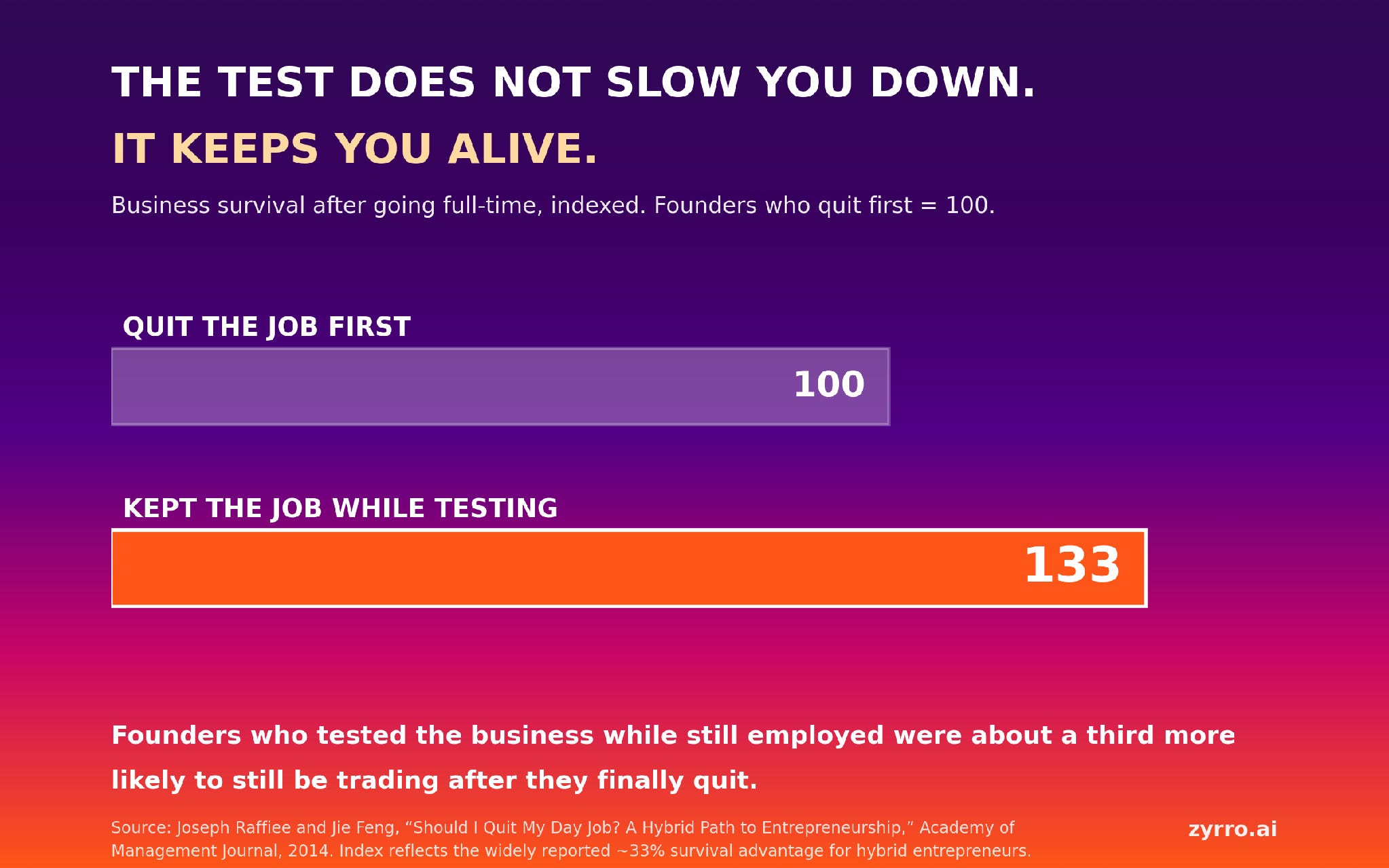
Data: Raffiee and Feng, Academy of Management Journal, 2014
I did it again at 52
In my forties I opened a shop that sold beds. It went broke. And I was distraught. That experiment cost me over $250,000 and a marriage.
To pay the rent I took a job selling houses, which I was not good at. My marriage ended. I spent about a year at my brother’s place beside a lake, working out who I was going to be next.
Then in 2009, back in Sydney with a new partner and a spare room, I started a blog.
Not as a leap. As a test. The real estate job still paid for the groceries.
I got up at 4:30 in the morning and wrote, five days a week, for five years. The affirmation arrived in small pieces from strangers on other continents, and the motivation grew out of the action rather than coming before it.
It went on to reach 33 million readers.
Nobody would call that a leap of faith. It was a two-year experiment that quietly grew teeth.
And again at 69
This year I sold my house. I am debt free with what I call runway money.
I want to be honest about the part nobody posts. I was anxious making that decision. A house is not only an asset. It is a container you have built a life inside.
But it was the same move at a larger scale. I did not gamble. I had spent a year saving every book, article and paper that caught my attention, then asked an AI what I had been repeatedly trying to understand.
Five questions came back. Each one had been running in the background of my life for years.
One of them became Zyrro, the company I am now building.
If that sounds late, consider what Pierre Azoulay, Benjamin Jones, J. Daniel Kim and Javier Miranda found when they examined US Census records covering millions of company founders. In “Age and High-Growth Entrepreneurship” they report that the mean age of founders of the fastest-growing one in a thousand new ventures is 45.
Not 25. Not 30. Forty-five, and rising with industry experience.
The reason should be obvious by now. Older founders have more evidence about themselves. They have run more experiments, whether they called them that or not.
Why nobody tells you this
The leap makes a better story than the test.
Nobody films eighteen months of Tuesday nights. There is no dramatic scene in which a man carefully compares three sales jobs over a school holiday. The algorithm does not reward a decision that took two years to become obvious.
So the version that travels is the version with the cliff in it.
And a generation of capable people sit still, waiting to feel brave enough for a jump that was never required, in a career they already know is wrong.
The bravery was never the point. The evidence was.
How to run the test
This is the method I have used at 27, at 52 and at 69. It has not changed.
1. Keep the job. It funds the experiment and removes the panic that makes people take bad offers.
2. Run the real thing at night. Small, real, with actual customers or actual readers. Not a plan. Not a course. Something that can fail in public this month.
3. Watch three signals. Does it make money. Are you good at it. Do you lose track of time doing it.
4. If all three fire, run a second version to check it was not luck. One summer, three jobs.
5. Then go. Not because you are certain, but because you have run out of reasons to wait.
Most people invert this.
They wait for certainty, then leap in a panic when the job becomes unbearable. Certainty never arrives. Evidence does, and it arrives faster than anyone expects once you start collecting it.
What it costs
The cost of running the test is small. Some Tuesday nights. A few weekends. Being told no by strangers.
The cost of not running it is a decade.
I have met plenty of people who regret a leap. I have never met one who regretted the experiment.
You are not looking for certainty. You are looking for a signal loud enough to act on.
Go and collect some evidence.
I write about what becomes more valuable in humans as AI becomes more capable. I am building Zyrro, an AI platform that reads your own history back to you — the decisions, the energy, the questions you keep returning to — so you can run the test on yourself in an afternoon instead of a summer.