

The Friction Economy: Every Great Company Killed One Thing
AI made doing things easy. Now the hard part is knowing what to do.

In the 1960s, Lockheed built a plane that leaked.
Not by accident. On purpose.
The SR-71 Blackbird sat on the runway and wept fuel onto the tarmac. Ground crews stepped around the puddles like it was weather.
The panels had been fitted loose. Deliberately.
Here is why. At full speed the Blackbird flew more than three times the speed of sound. And the air alone — just air, the same stuff you are breathing right now — heated its titanium skin past 250 degrees. The whole plane stretched. Inches longer in the sky than on the ground.
So the engineers built it loose and let the sky seal it shut.
The fastest air-breathing plane ever made had one true enemy. Not gravity. Not distance. Not the limits of the engine.
Air. Nothing but air.
Now leave the sky.
Voyager 1 passed Saturn in 1980 and stopped pushing. No engine has driven it forward since. Forty-six years of nothing.
It is still moving at about 61,000 kilometres an hour.
This November it becomes the first thing humans made to sit a full light-day from home. Send it a message and you wait a day for it to arrive. Then another day for the answer.
No engine. No fuel burn. No push. Just nothing in the way.
And here is the part that should stop you.
When a spacecraft comes home, it does not use brakes. It falls into the atmosphere and lets the air do the work. Air alone strips away almost all of that speed. The parachutes only handle the leftovers.
Friction is strong enough to stop a spaceship.
And you swim in it. All day. Every day.
We are trained to want a bigger engine. More hours. More effort. More tools. Push harder, they say, and you will go further.
But the fastest thing we ever built has no engine running at all. It just has nothing rubbing against it.
That is the law. And almost nobody applies it to their own life.
The history of everything
In 2007, a man walked on stage holding a phone with almost nothing on it. No keyboard. No stylus. No manual. One button.
His rivals laughed. Real phones had forty buttons you could feel in the dark.
Everyone thought Apple was selling technology. It wasn’t. Apple was selling the removal of it. Dieter Rams, the designer Jobs studied like scripture, said it in three words. Less, but better.
Because here is a secret hiding in plain sight.
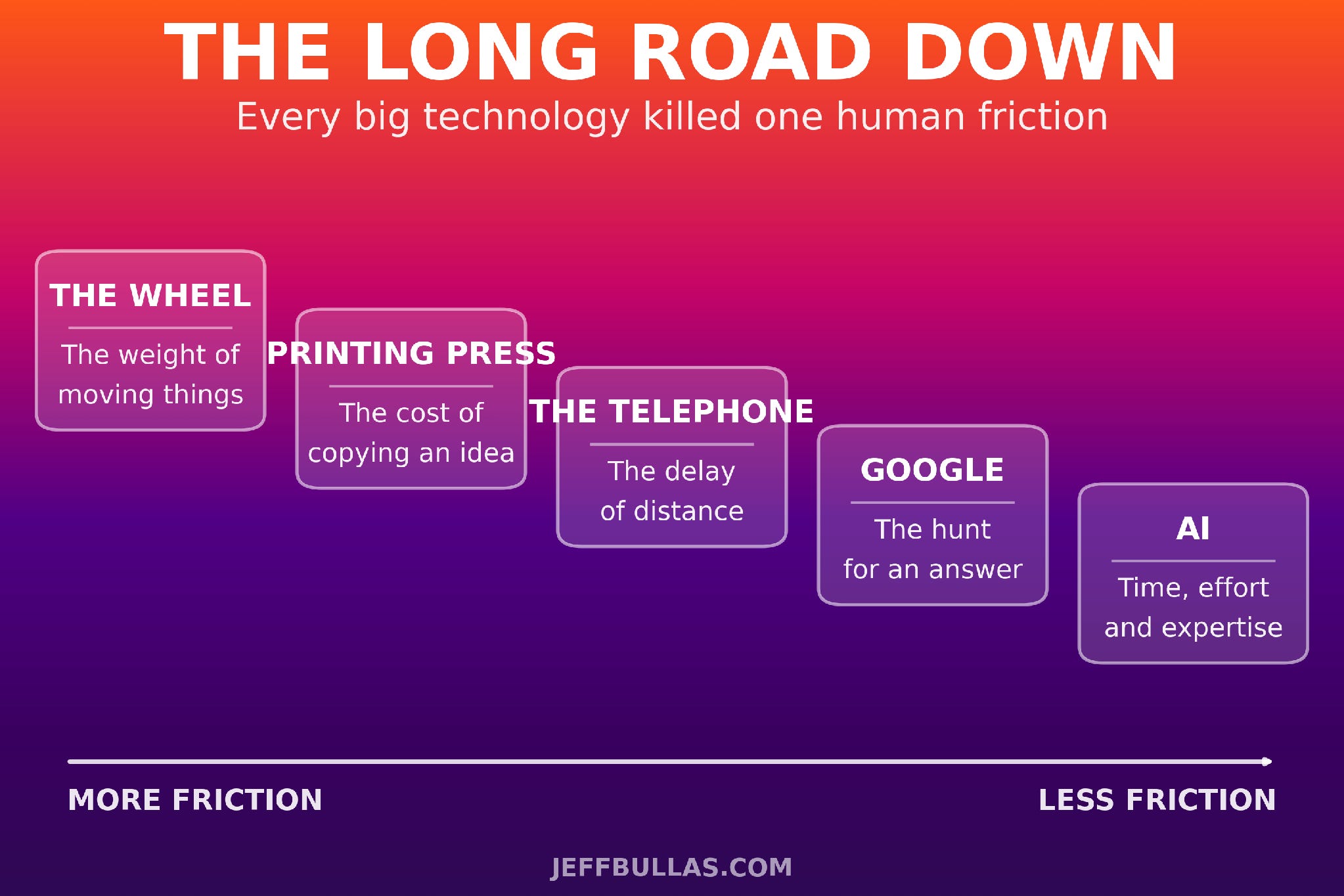
The history of civilization is not the history of intelligence. It is the history of friction, and how we keep dragging it toward zero.
The wheel has no chip and no genius. It turns dragging into rolling. Gutenberg took a book that cost a monk months of candlelight and let one machine flood a city in a week. Google took an answer that lived at the bottom of a library and put it behind a blinking line.
Nobody paid for any of it because it was smart.
They paid because it was easy.
The store that sold fewer jams
Sheena Iyengar set up a tasting booth in a fancy grocery store. Some days she laid out twenty-four jams. Other days, six.
The big table pulled the bigger crowd. More colours. More choice. People love a spread.
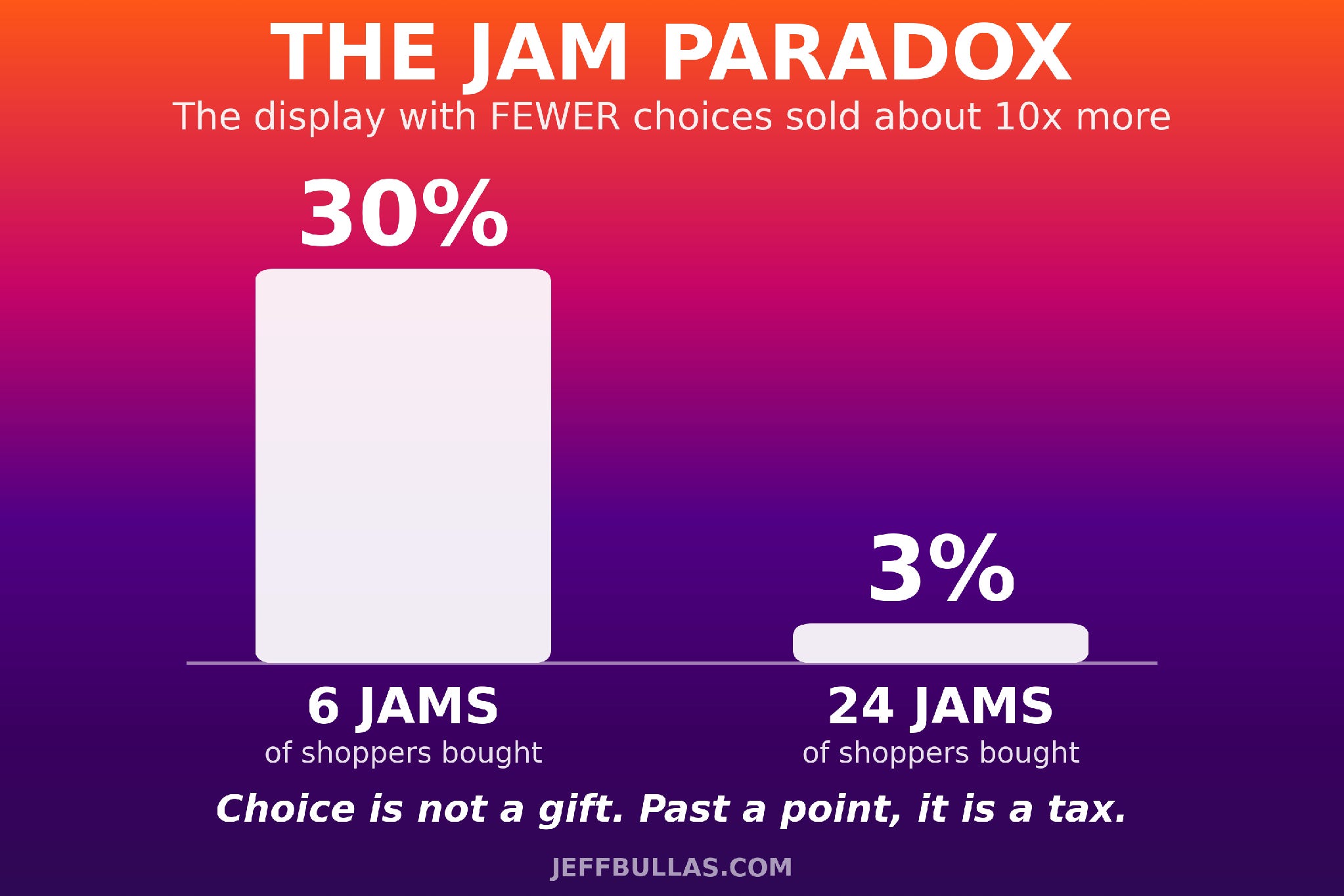
At the checkout the numbers flipped. From the table of six, about three in ten shoppers bought a jar. From the table of twenty-four, roughly one in thirty.
Fewer jams. Around ten times the sales.
Choice is not a gift. Past a point, it is a tax.
This is the mind’s oldest problem. Daniel Kahneman showed that careful thinking is slow and expensive, and we avoid it whenever we can. John Sweller gave the cost a name — cognitive load. Working memory is a small desk. Pile too much on it and things fall off the edge.
Every extra button, every extra choice, every wait, how does this work again lands on that little desk.
Great products don’t add to the desk. They clear it.
The billion-dollar cut
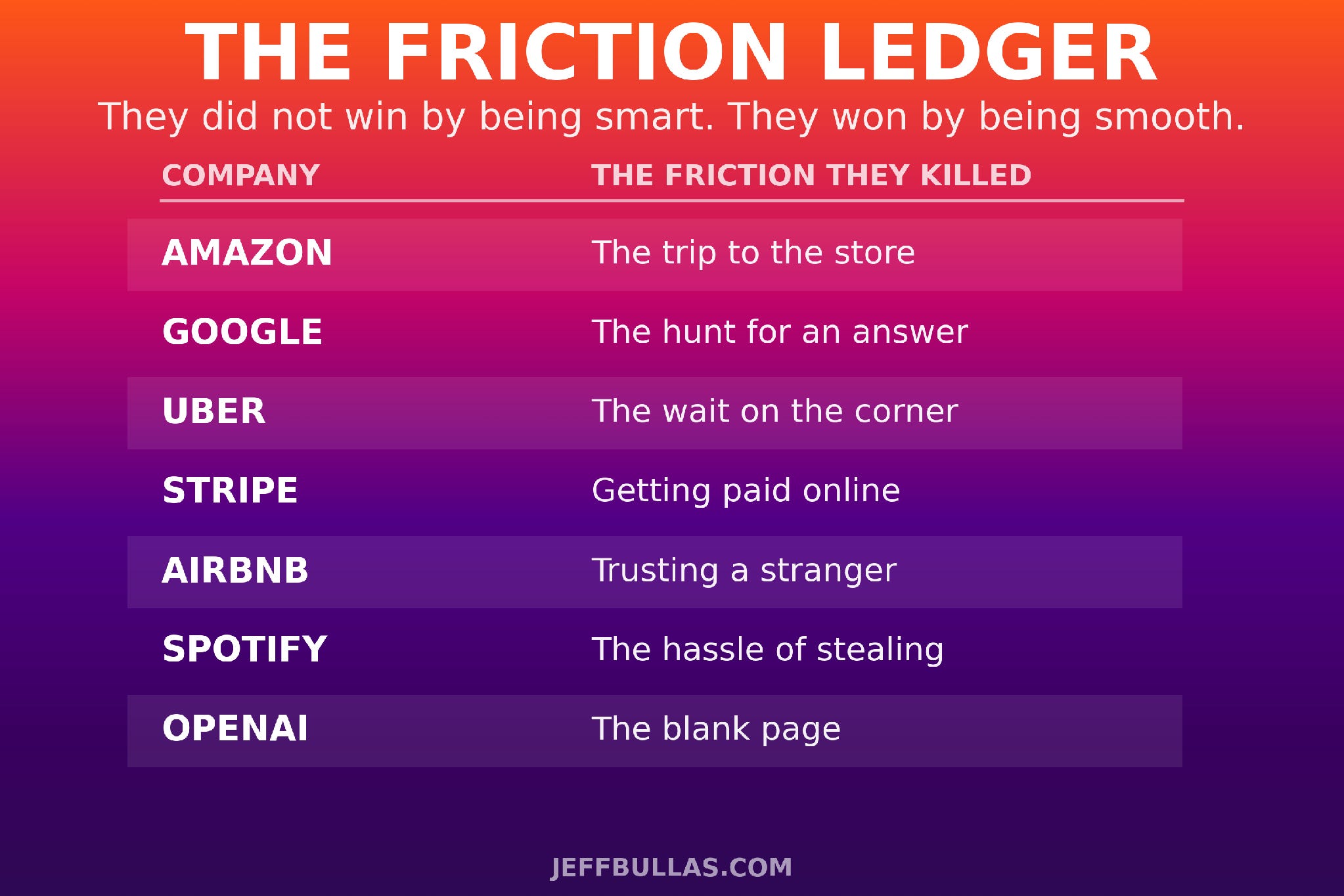
Every giant of our age got rich the same way. They found a friction so normal we had stopped noticing it, and they cut it out.
Amazon killed the trip to the store, then killed the checkout. Google killed the hunt for an answer. Uber killed the wait and the arm in the air. Stripe turned weeks of banking pain into a few lines of code. Airbnb made a stranger safe enough to sleep beside. Spotify beat free, because pressing play was easier than stealing.
None of them won by being the smartest. They won by being the smoothest.
What AI actually collapses
Here is where the noise gets it wrong.
People argue about whether the machines are conscious, or dangerous, or clever enough to take your job. Interesting questions. Wrong questions.
AI is not mostly a leap in intelligence. It is a collapse in cost.
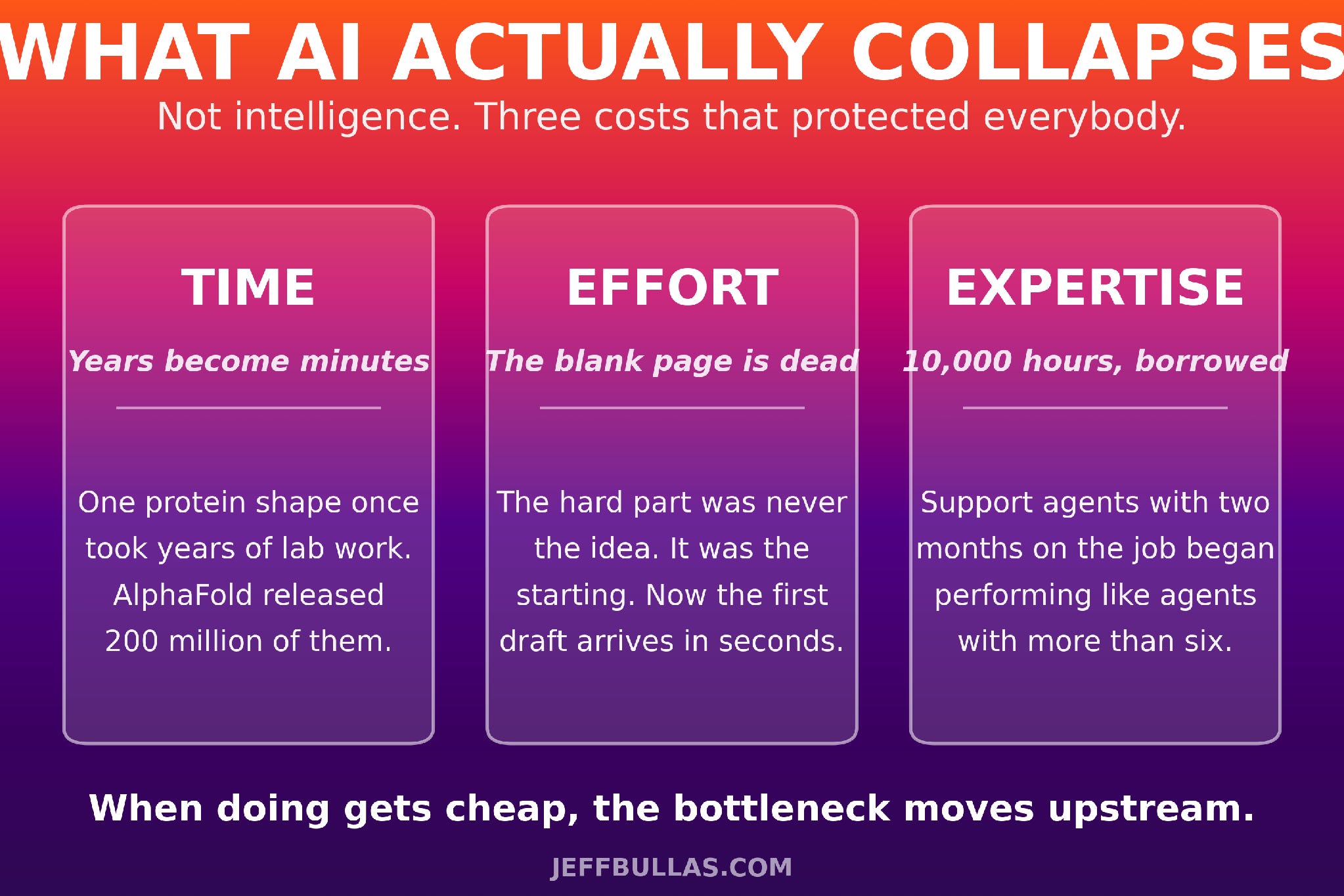
Three costs. Time. Effort. Expertise. The three walls that protected every career and every craft for the whole of human history.
Time. In 1957 a scientist worked out the shape of a single protein and it made him famous. For sixty years, finding one of those shapes could swallow years of a life. Then AlphaFold released predictions for more than 200 million of them.
Effort. The blank page is dead. Not the good part of writing. The frozen part. The Sunday night staring.
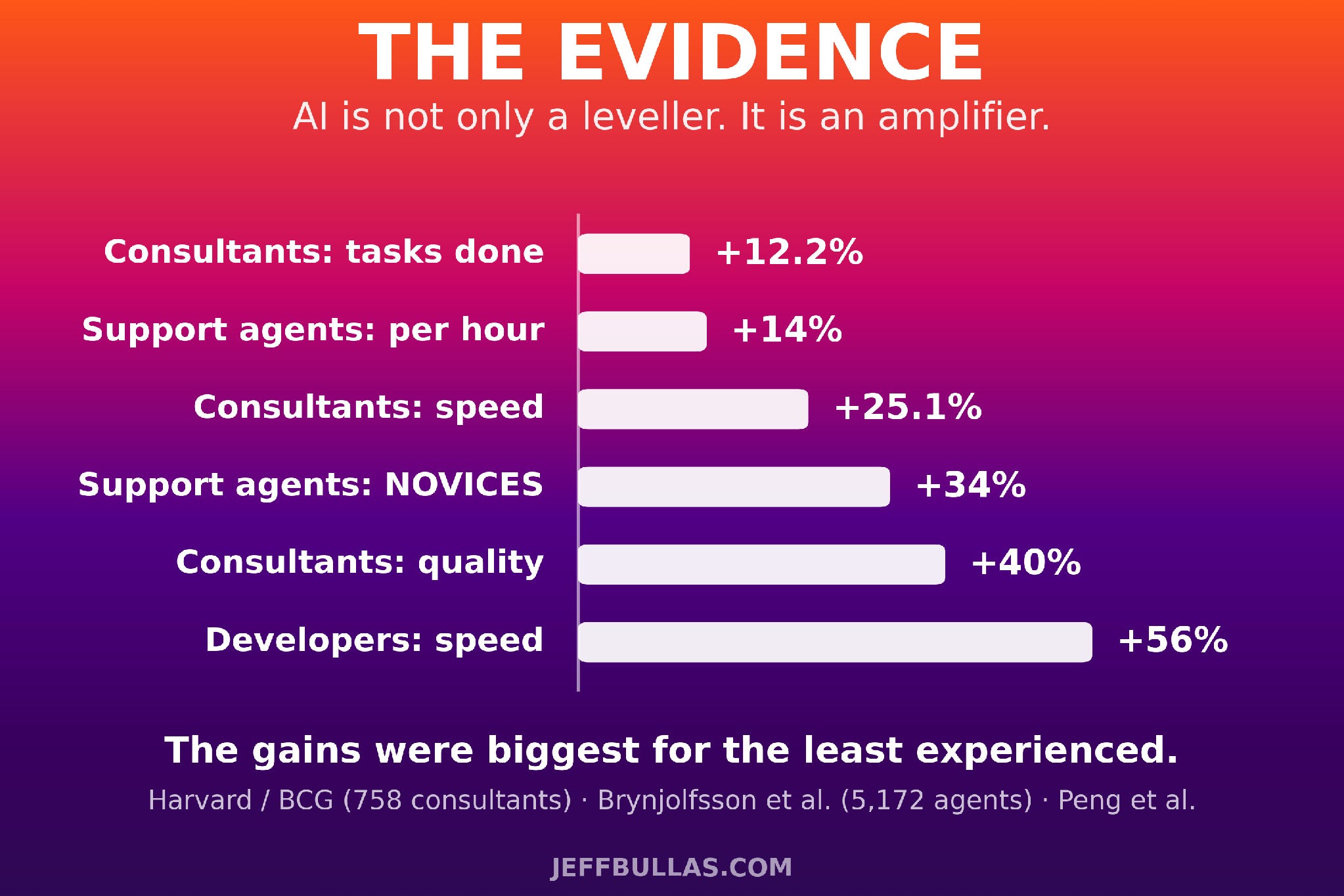
Expertise. Researchers watched 5,172 customer support agents get an AI assistant. They solved around 14% more problems an hour. But look closer. The newest and weakest jumped by about a third. Agents with two months on the job began performing like agents with more than six.
Expertise stopped being a wall. It became a download.
It is not just a leveller
AI does not only drag beginners up to the middle. It lifts the people who already know what they are doing.
Harvard and BCG ran an experiment on 758 consultants. The ones using AI finished around 12% more tasks, about 25% faster, and human graders scored their work roughly 40% higher. Developers in another trial finished their coding task more than 50% faster.
AI is not the end of human work. It is the end of the boring middle of human work.
Now the twist. That same Harvard study handed the consultants a task the machine was not good at. The people using AI got it wrong far more often. Around nineteen percentage points more often.
The machine was not loud about it. It was smooth. It was confident. It was wrong.
So the skill that decides your next ten years is not prompting. It is knowing when to trust the answer and when to walk away from it.
That is judgment. And judgment is downstream of one thing only: knowing what you actually believe.
Here is the strange part
The smarter our machines got, the more lost we became.
We spent ten thousand years making the world easier to act in. We never made ourselves easier to be.
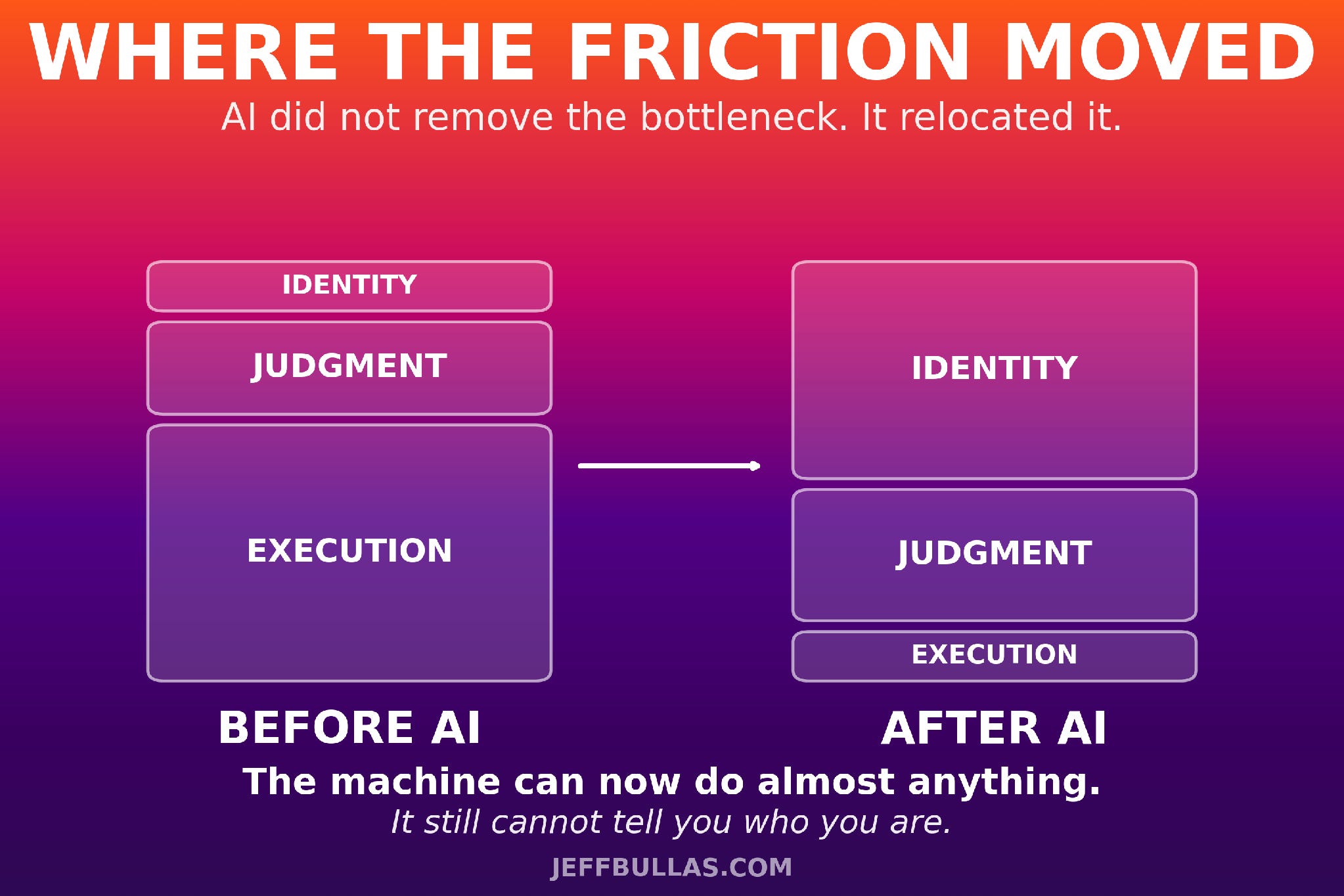
When the cost of doing falls toward zero, the bottleneck does not vanish. It moves upstream. Away from the hands. Toward the head.
The question stops being can you make it. It becomes should you — and what is even yours to make?
The machine can now do almost anything. It just cannot tell you who you are.
Identity as infrastructure
Say the word identity and most people picture a logo. A colour palette. A vibe.
I mean identity as an engine. A decision engine.
Watch what happens when you know who you are. The world hands you twenty-four jams and you don’t freeze. You reach for yours. You say no before the salesman finishes his sentence. You feel the wrong opportunity in your gut, the way you feel a wrong door.
Knowing yourself is the cheapest way to choose. It clears the little desk. It shrinks the menu. It ends the fatigue before it starts, because half those choices were never yours to make.
Roads carry cars. Wires carry power. Search carries answers.
In a world where the machine can make anything, the thing that carries you is a clear sense of you. That is not branding. That is infrastructure. It is the ground I am quietly building on with Zyrro.
We built machines to remove the friction of doing, and we exposed the friction of being. The blank page is solved. The blank self is not.
The Friction Economy
So here is the idea I want to leave in your hands.
The winners of the next decade will not be the ones with the biggest model. Intelligence is becoming a commodity, cheap and everywhere, like clean water from a tap. Nobody brags about their tap.
The winners will be the ones who remove the most friction from a human life.
Founders, stop asking how smart you can make it. Ask how much you can take away.
Creators, output is no longer a moat. Everyone has the machine now. A point of view a model cannot fake is your last unfair advantage.
Leaders, every fuzzy decision and wasted meeting is drag on somebody’s small desk. Clear the desk and watch them fly.
And if you are reading this in a cubicle, quietly thinking there has to be more to life than this — the play is the same. Get so clear on who you are that the wrong doors stop tempting you.
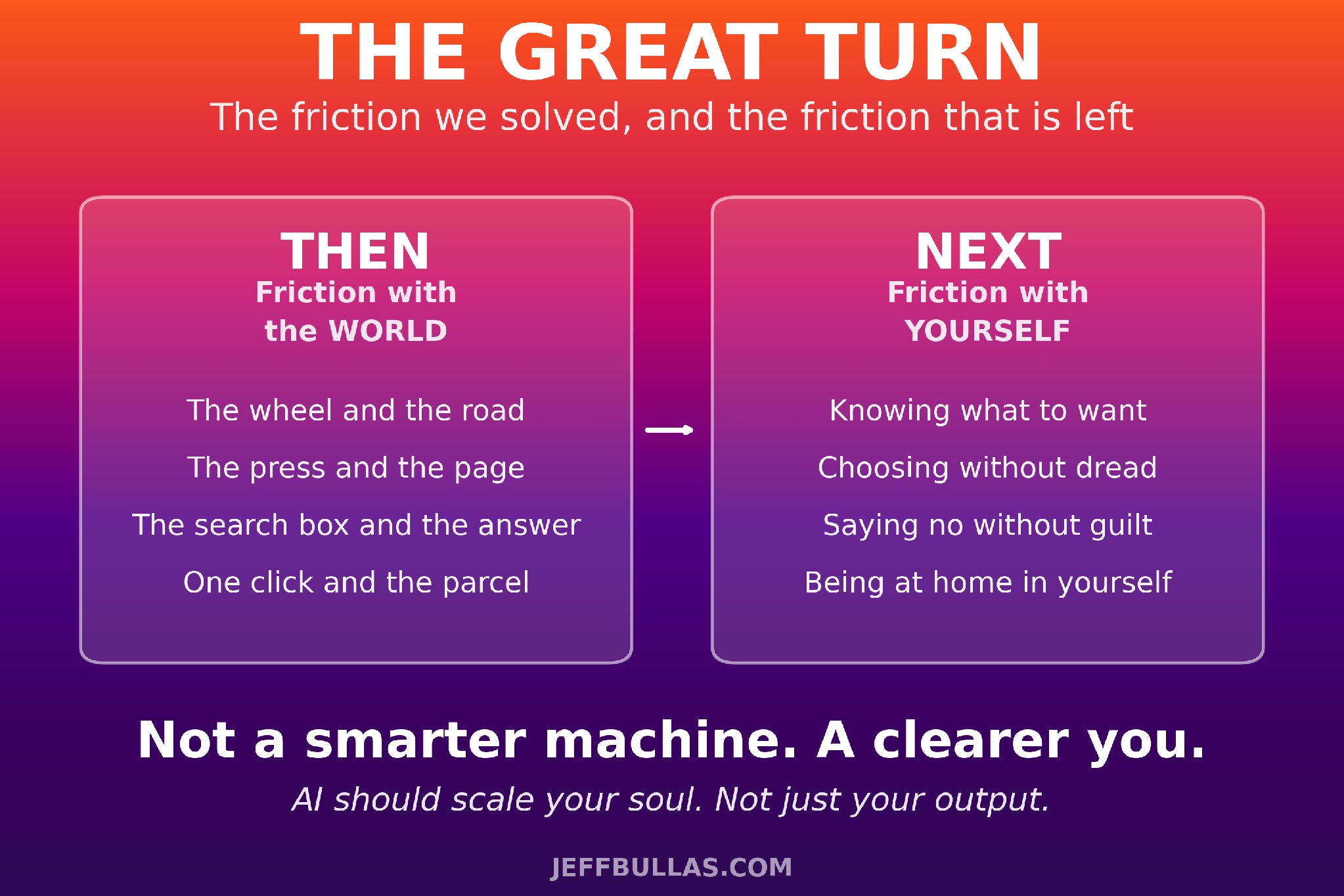
Every technology before this one reduced the friction between you and the world outside.
The wheel and the road. The press and the page. The screen and the answer.
The next one reduces the friction between you and the world inside.
Not a smarter machine. A clearer you.
We already know how to make things without effort. Now the work is knowing what is worth making. And who we are when we make it.
AI should scale your soul. Not just your output.
That is the whole game. It always was.