

Nobody Ever Found a Passion
Everything that ever took over a life started as a small curiosity that almost got ignored

Here is a word you have used your whole life without once looking at it.
Passion.
For four hundred years, it did not mean what you think it means.
It comes from the Latin pati. And its oldest sense in English was not love, or ambition, or a calling. It meant the state of being acted upon by something outside yourself. Something done to you. Something that took you.
Sit with that.
A passion was never a thing you went out and got. It was a thing that arrived and claimed you.
Which makes the modern version of the word almost funny. We turned something that takes you into something you shop for.
Here is the second surprise.
“Follow your passion,” as career advice, is younger than the mobile phone. In 1970, Richard Bolles published What Color Is Your Parachute, one of the first books to tell ordinary people to look inward before choosing a job. In 1988, PBS aired Joseph Campbell’s The Power of Myth, and “follow your bliss” slipped into the language. Somewhere between those two, the ideas fused. By the 1990s, career advice had a new commandment.
Not four hundred years old. Forty.
So we are all walking around obeying a rule that is younger than most of the people reading this. And obeying it badly, because it is built on a mistranslation of its own name.
You are not supposed to find it.
You are supposed to be taken by it.
(There is a way to see this coming. I will show you, before we finish.)
It never announces itself
Nobody ever has seized on a Tuesday buy a call to your unknown mission.
That is the part the graduation speech leaves out. What takes you does not arrive as a thunderclap or a calling written on the sky. It arrives as something almost too small to notice.
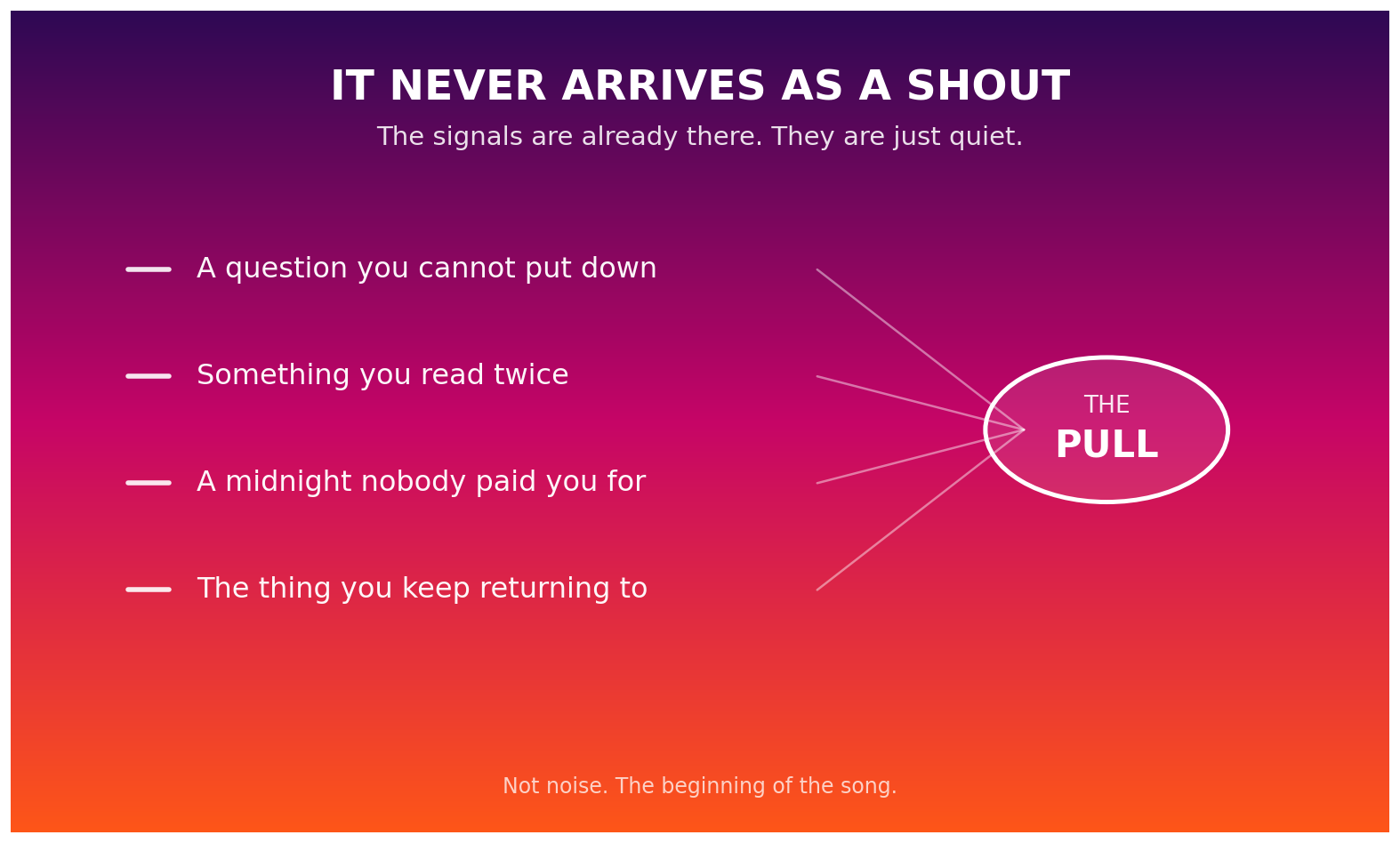
A question you cannot put down.
An article you read twice for no reason.
A midnight you lose to a subject nobody is paying you to care about.
You have had these. You have them right now. You just filed them under nothing, because they did not look important enough to be your life.
They are not nothing. They are the first signals, arriving at low volume.
Steven Spielberg told Harvard’s graduating class that your conscience shouts what you should do, but your intuition only ever whispers what you could do. And once he learned to hear it, he said, certain projects began to pull him toward them, and others quietly lost their grip.
Not a shout. A pull.
The whisper is quiet on purpose. It is quiet because it is not trying to convince you. It is trying to find out whether you are the kind of person who leans in.
Why most whispers die young
Now here is where it goes wrong for almost everybody.
Paul O’Keefe, Carol Dweck and Gregory Walton ran five studies out of Stanford, published in Psychological Science in 2018. The fifth one is the one I cannot forget.
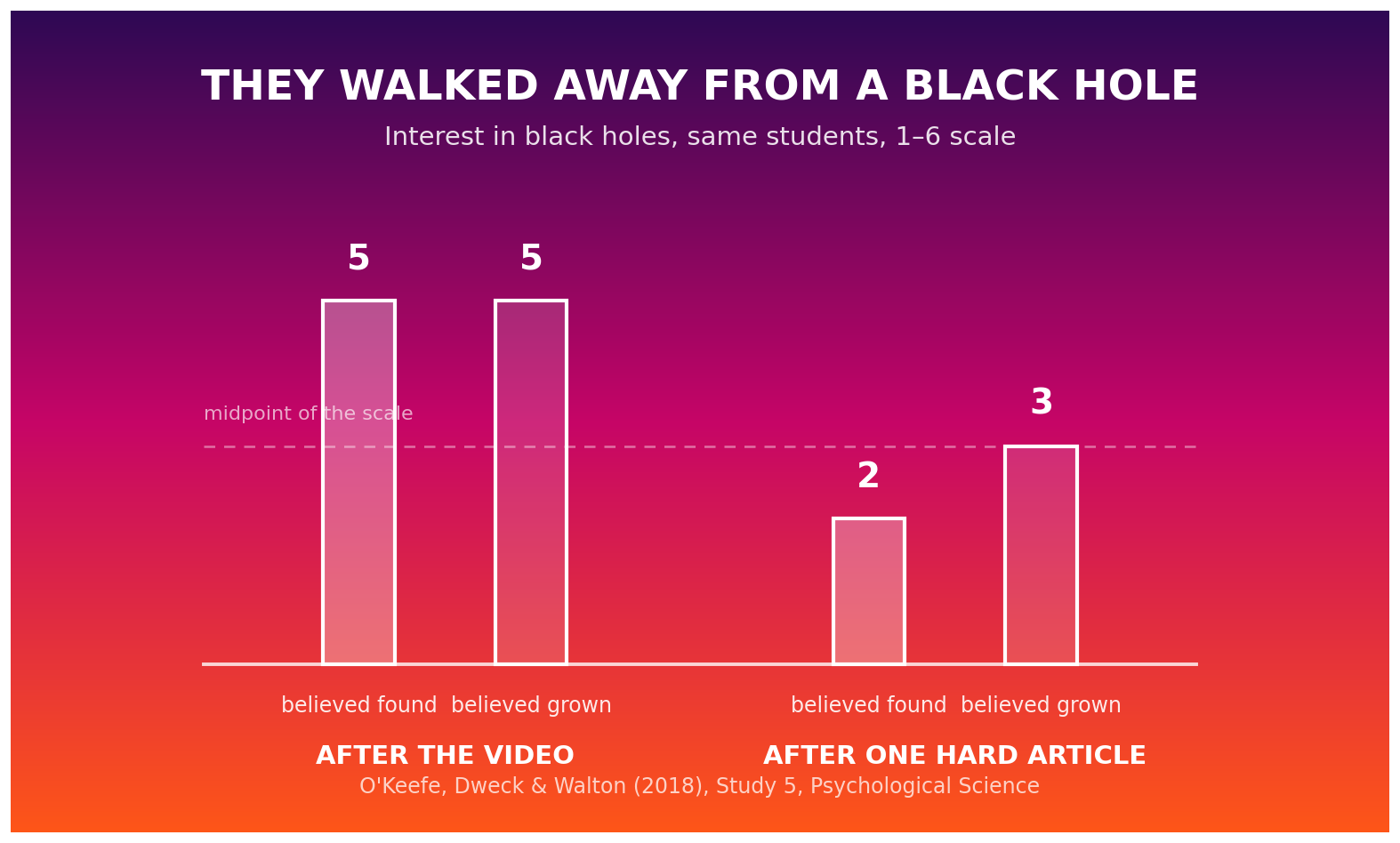
They showed students a video about black holes. Everyone was enchanted. Both groups rated their interest at roughly five out of six. No difference between them. The whisper had landed.
Then they handed the same students a genuinely difficult academic article on the very same subject.
Among students who believed that passions are found, interest collapsed to a predicted two out of six. Below the midpoint. Below neutral. Fifteen minutes after being enchanted.
Among students who believed that passions are grown, interest held at three. Same article. Same difficulty. Same black holes.
One belief. One hard paragraph. A three-point swing on a six-point scale, in under twenty minutes.
Look at what actually happened there.
The subject did not stop being magnificent. Black holes did not get less astonishing between the video and the article.
What happened is that one group had been taught that if a thing is truly yours, it will feel easy. So the moment it did not, they read the difficulty as a verdict. Not mine. Wrong door. Move on.
They walked away from a black hole.
And here is the part that should make you angry on your own behalf. Everyone who ever told you to find your passion handed you a reason to leave, and called it encouragement.
The villain here is not the woman in the gown on the stage. She meant it kindly. She believed it herself.
The villain is a forty-year-old idea, repeated so often that nobody stops to check whether it is true.
What actually grows
Because interest does have a shape. It just is not the shape we were sold.
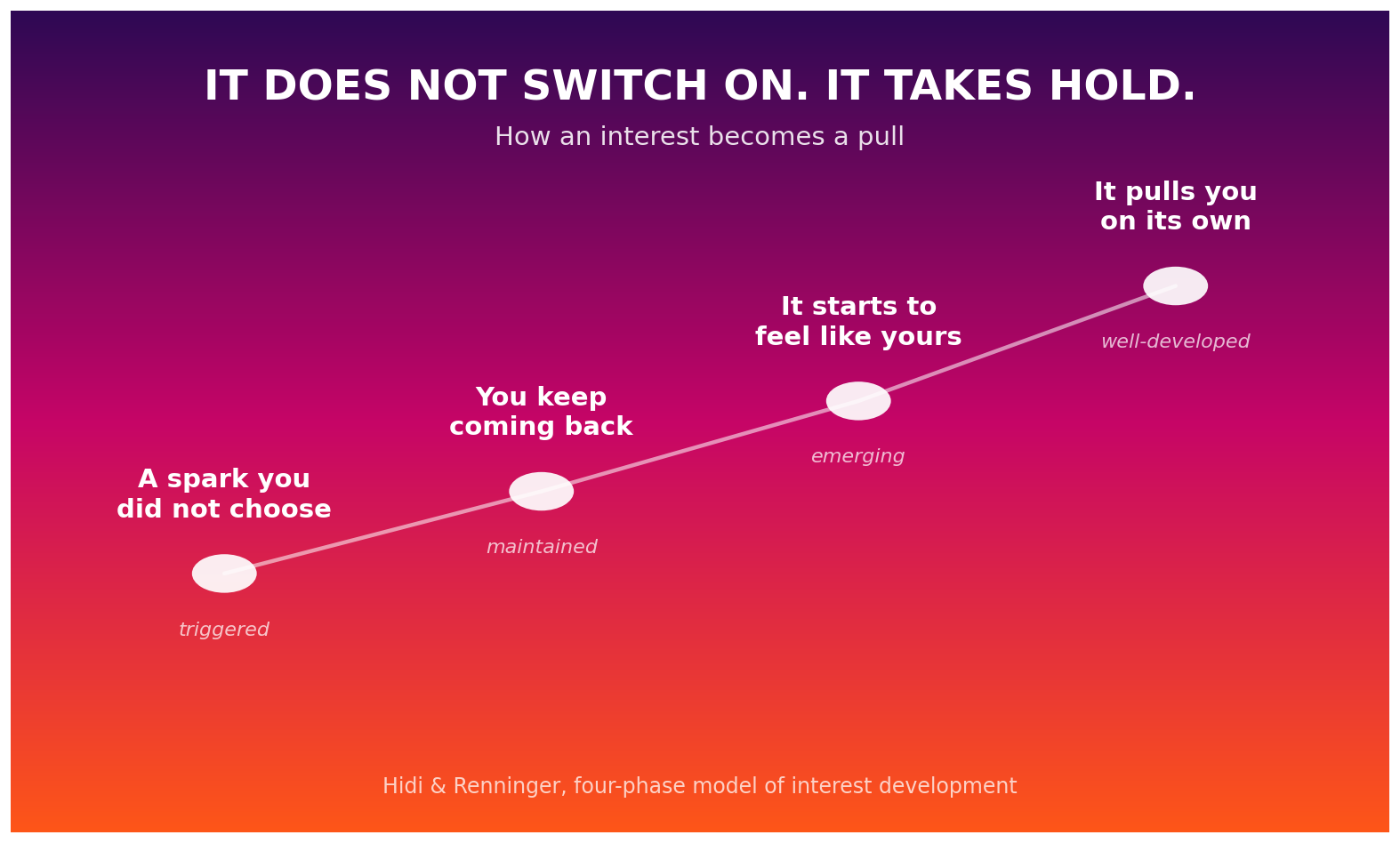
Suzanne Hidi and Ann Renninger mapped it. Passion does not switch on. It comes in stages, and each stage is quieter than you would expect.
First, a spark you did not choose. Something catches you.
Then, you find yourself returning. You did not decide to. You just kept coming back.
Then it starts to feel like yours. You go looking without being sent.
Then, at last, it pulls. And you stop having to push at all.
Read that last stage again.
That is the moment the thing you were nurturing turns around and starts nurturing you. The moment it stops being something you do and becomes something that has you.
Most people never get there. Not because they lacked the fire. Because they threw away the invitation while it was still small and quiet and easy to mistake for nothing.
Five years in the dark
Let me tell you something I have never been able to explain properly.
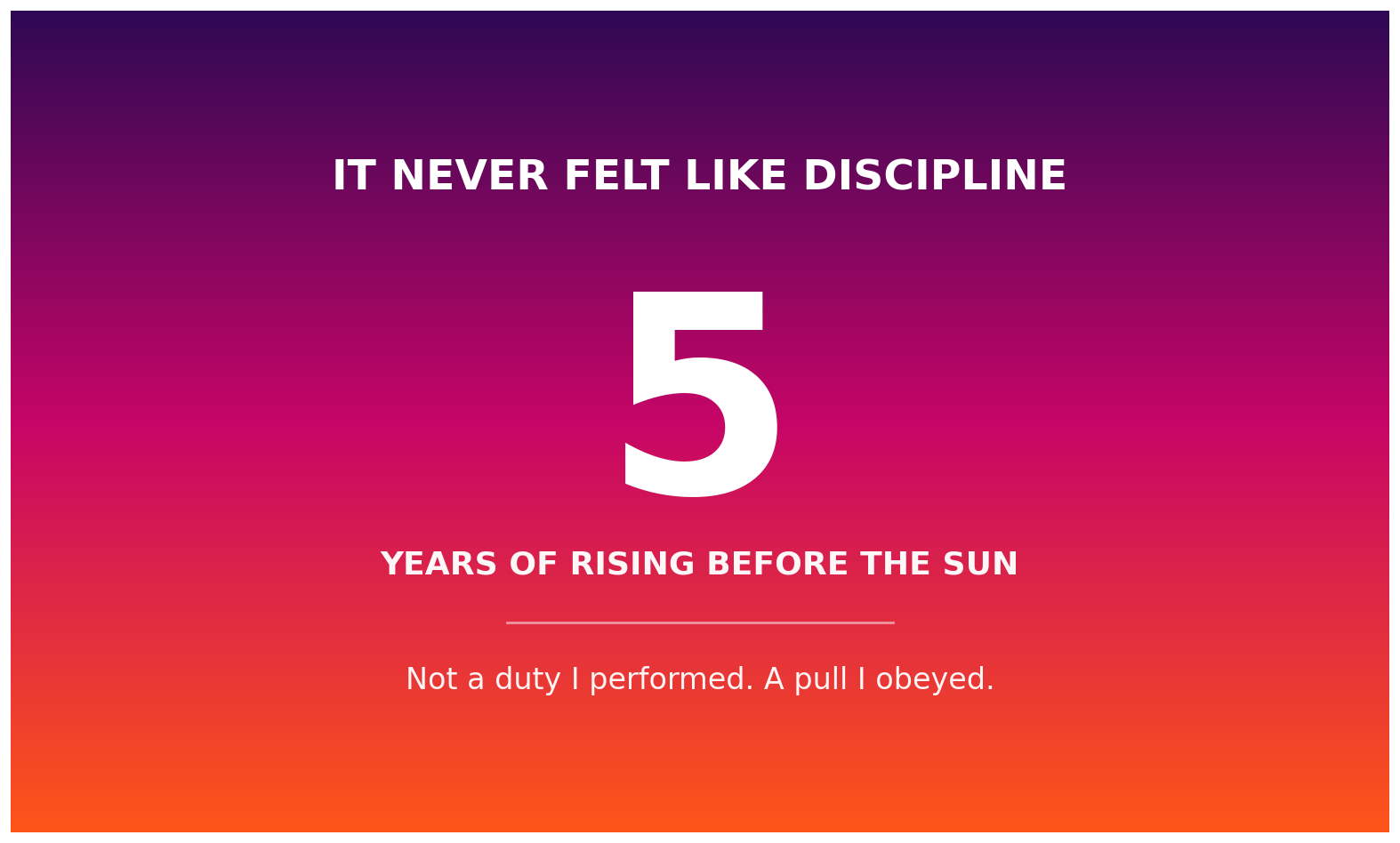
Years ago I started getting up before the sun. Not once. Not for a season. For five years.
The house was dark. The street was silent. Nobody asked me to. Nobody paid me at the start. There was no evidence any of it would lead anywhere.
People assume that took discipline.
It did not. That is the thing I cannot make people believe.
I was not gritting my teeth in the dark. I was going toward something. Every morning I found out a little more, and every morning the wanting got stronger, not weaker. Some days I woke before the alarm because I could not wait.
It was not a duty I performed. It was a pull I obeyed.
And I did not choose it, exactly. It chose me first, in the form of a small curiosity I could not put down, and I was foolish enough or lucky enough to keep leaning in until it had me completely.
Then one ordinary morning I looked up and it was everywhere. A thing I cared about more than sleep. Readers on the other side of the world. A life I could not have described on that first cold morning if you had paid me.
What the Sirens were actually singing
We have the story wrong, and the true version is better.
In Book 12 of the Odyssey, Circe warns Odysseus about the Sirens. Their meadow, she says, is heaped with the bones of men, the skin still rotting off them.
Every painting since has made the Sirens beautiful. Bare shoulders. Sea spray. Temptation of the obvious kind.
But Homer never describes them. Not once. He gives them no faces, no bodies, not even a number.
Because their beauty was never the weapon.
Listen to what they actually sing as Odysseus sails past. They call him by name. They promise that no man has ever passed without hearing their honeyed voices, and that every man who does sails on wiser than he came. They say they know everything the Greeks and Trojans suffered at Troy. They say they know all that comes to pass on the fertile earth.
They know everything.
That is the seduction. Not skin. Knowing.
The most dangerous song in Western literature is an offer to satisfy your curiosity. The bones on that shore belong to men who could not stop wanting to find out.
And notice what Odysseus does, because this is the part we forget.
He does not plug his own ears. He gives the beeswax to his crew and has himself lashed upright to the mast, with orders that if he begs to be freed they must bind him tighter.
He wanted to hear it.
He built a structure so that he could be taken by the song and survive it.
That is the whole thing. Not resisting the pull. Not pretending you are above it. Choosing to be seduced, on purpose, with something solid at your back.
The Odyssey
Here is the turn it took me years to see.
The Sirens sang to Odysseus by name. They knew exactly who was sailing past.
But the song runs both ways.
You are transmitting too. Every question you cannot drop. Every subject you circle back to. Every midnight nobody paid you for. Those are signals going out from you, constantly, whether you notice them or not.
A song is only a signal that found someone tuned to it.
And the sad part is not that nobody is listening to yours.
It is that you are not.
Seduction
I would be lying to you if I stopped there.
A pull that strong takes things with it. It took my evenings. It took conversations where I was in the room and nowhere near it. It took the ordinary balance that sensible people manage to keep.
There were bones on my shore too.
The seduction is real and the cost is real and they arrive in the same package. Anyone who tells you otherwise is selling something.
But I would not undo it. Not one dark morning of it.
Because the alternative was a life where nothing ever grabbed me hard enough to cost me anything. And I have met people living that life. They are comfortable. They are also, quietly, starving.
You do not have to wait to see it
Steve Jobs told Stanford’s graduating class that hindsight was the only lens that ever worked for him. In the moment, he said, there was no way to see the shape of his own life. Only years later did the pattern appear.
He was right. And there is a reason it took him ten years.
Frederic Bartlett spent his life studying memory and found it does not replay the past. It rebuilds it, from fragments, every single time you reach for it. Each retelling drops what seemed unimportant. Sharpens what seemed to matter.
So hindsight is not clarity. Hindsight is forgetting, doing you a favour. Wait long enough and your memory quietly deletes the noise and hands you back something that looks like a line.
Looking forward is impossible. Nobody can read a life before it is lived.
Looking back is easy, but it costs you a decade and shows you an edited version.
There is a third way to look, and it was not available to a twenty-year-old sitting in a calligraphy class in 1972.
Looking now.
While you are still inside the pattern. While the small signals are still fresh enough to read. Before forgetting has quietly deleted half of them and called the rest a story.
You do not have to wait until you are old enough to turn around.
You are many
One last thing the old advice gets wrong.
It tells you there is a single true self, hidden somewhere, and one passion belonging to it. One path. One you.
You are not one thing. You never were.
Walt Whitman knew: “I am large, I contain multitudes.”
You are the curious one and the cautious one. The dreamer and the closer. The child who drew for hours and the adult who learned to read a room.
And here is what I want you to know, because I think you already suspect it.
The seduction does not happen when one of those selves wins. It happens when they stop fighting and point the same way. When the curious one and the careful one and the ambitious one all lean toward the same horizon at once.
That is when the song gets loud enough to hear over everything else. That is the moment you stop being able to argue with it.
An idea is safe in a drawer
But nothing sings to you from inside your own head.
An idea can sit in a filing cabinet for a lifetime. Safe. Tidy. Never once tested.
You cannot think your way into being taken. You have to move, in public, where the world can answer you back.
So make the small thing. Publish the rough version. Say the sentence out loud to someone who might disagree.
Done is better than perfect, and a thing that exists beats a masterpiece that never left your head.
Every action becomes another dot. Another point in a pattern you will be able to read far sooner than Jobs could.
You do not find the line by studying the map.
You find it by sailing.
The last word
There is something already whispering to you. There always has been.
It is small. It is probably inconvenient. It has almost certainly been dismissed by you as a distraction from your real life.
It is not a distraction. It is a signal, and it is meant for you.
You do not have to be brave enough to know where it leads. You only have to be curious enough to lean toward it one more time. And then again the week after.
Because passion was never a thing lying in a field, waiting for someone lucky to walk past.
It is a song. Faint at first. Aimed at exactly one person.
And if you sail close enough, often enough, it will stop being something you are straining to hear.
It will start calling you by name.
Sources
O’Keefe, P. A., Dweck, C. S., & Walton, G. M. (2018). Implicit theories of interest: Finding your passion or developing it? Psychological Science, 29(10), 1653-1664. https://pmc.ncbi.nlm.nih.gov/articles/PMC6180666
Hidi, S., & Renninger, K. A. (2006). The four-phase model of interest development. Educational Psychologist. https://works.swarthmore.edu/fac-education/12/
Homer, The Odyssey, Book 12 (Sirens episode, lines 39-54 and 153-200).
Newport, C. Ancient Complications to Modern Career Advice. https://calnewport.com/ancient-complications-to-modern-career-advice/
Bartlett, F. C. (1932). Remembering: A Study in Experimental and Social Psychology. https://pmc.ncbi.nlm.nih.gov/articles/PMC3815569/
Steve Jobs, Stanford Commencement Address (2005). https://news.stanford.edu/stories/2005/06/youve-got-find-love-jobs-says
Steven Spielberg, Harvard Commencement Address (2016). https://www.harvardmagazine.com/2016/05/steven-spielberg-commencement-address-2016
Walt Whitman, “Song of Myself,” 51. https://poets.org/poem/song-myself-51
P.S. This is exactly what I am building now. A way to see the signals you are already giving off, read the pattern while you are still standing inside it, and act on it before it goes quiet. If that sounds like you, come and stand at the front of the line: [YOUR ZYRRO LINK]