

Territory
How the world's first mega-corporation 400 years ago became an empire and why the AI giants are repeating it

A private company once had an army twice the size of its own country’s military.
Not a nation. A company.
It had 260,000 soldiers. It ruled 200 million people. It controlled half of all the trade on Earth.
It collected taxes. It declared wars. It decided who ate and who starved.
It was called the East India Company.
And we are watching the sequel.
The first mega corporation
The East India Company was born in 1600 with a piece of paper.
Queen Elizabeth I gave a group of London merchants a royal charter. A legal monopoly on trade with the East.
That piece of paper was the moat. No competitor could cross it.
For the first hundred years, the company traded. Spices. Silk. Cotton. Tea.
Then something changed. Trading wasn’t enough.
The company raised its own army. It built its own forts. It made its own treaties with kings.
By the 1800s it wasn’t a business operating in India. It was the government of India. A corporation had become an emperor, and nobody had voted for it.
At its peak the company accounted for half of the world’s trade in commodities like cotton, silk, tea and spices. Nearly one pound in every ten collected by the British taxman traced back to it.
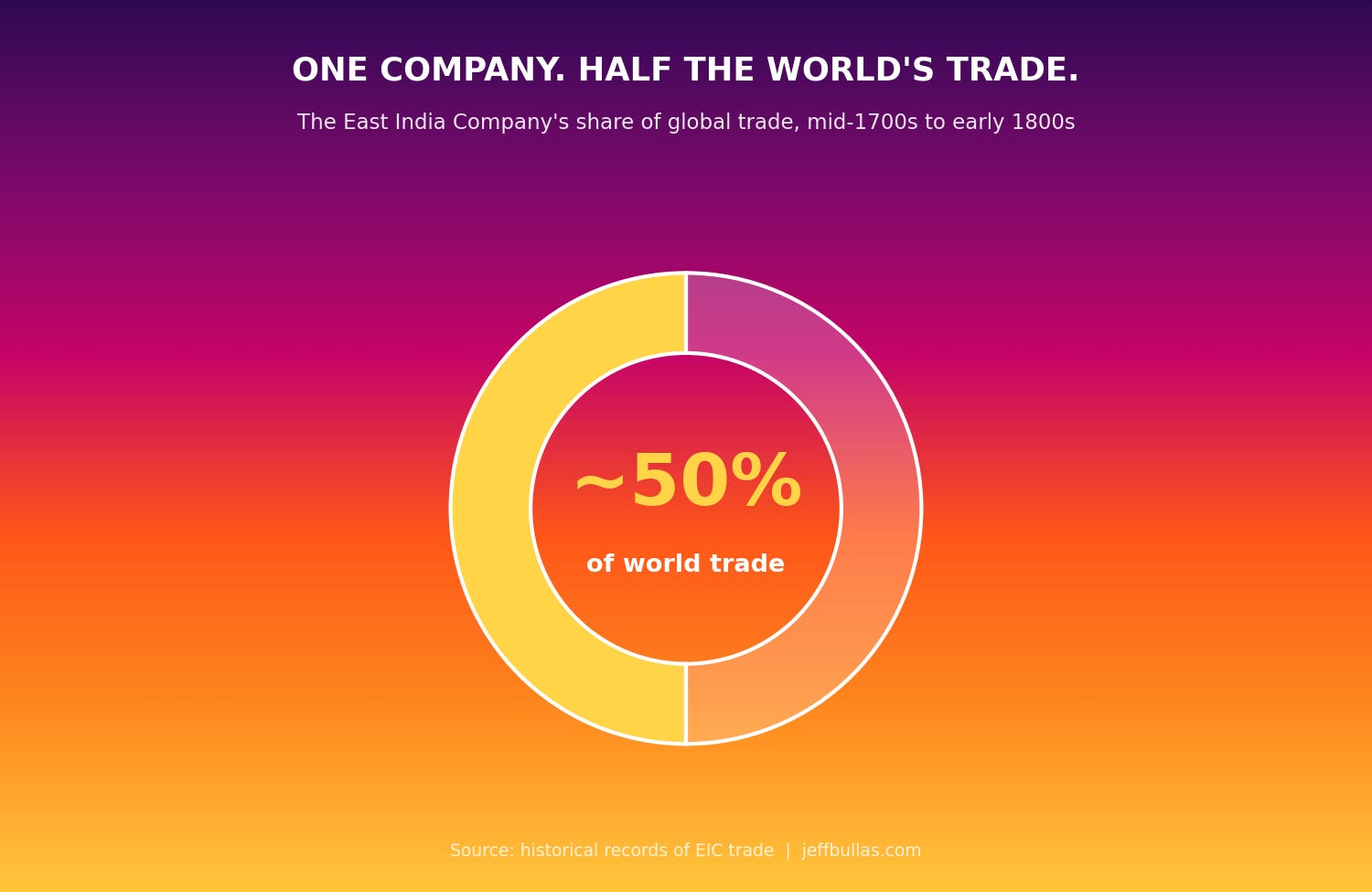
At its height, one private company handled around half of global trade.
Its private army of 260,000 was twice the size of the British Army and enough to conquer territory, crush competitors, and force one-sided contracts on kings.
Shareholders in London decided the fate of farmers in Bengal.
And we are going to see that pattern again.
This century. 400 years later.
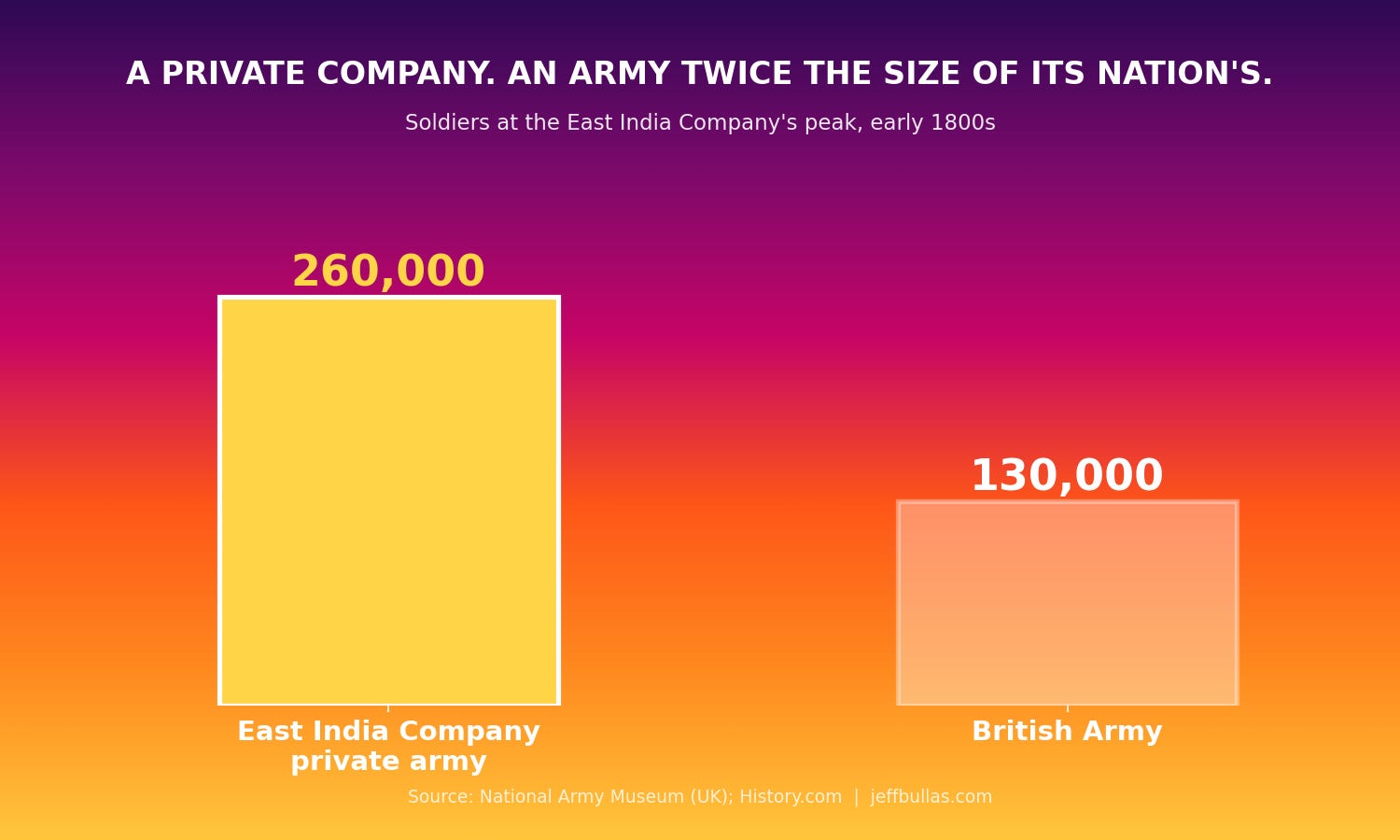
The company’s army dwarfed the army of the nation that chartered it.
The invention that built the modern world
To understand how a company became an empire, you have to go to Amsterdam. To the year 1602.
That year, the Dutch created the East India Company’s great rival: the Dutch East India Company, known as the VOC. And with it, they invented something that changed human history more than any battle ever did.
The tradable share.
For the first time, an ordinary person could buy a small piece of a giant venture. A baker. A weaver. A widow. Anyone with a few guilders could own a slice of ships sailing to the other side of the world.
And they could sell that slice to someone else. So Amsterdam built a place to do the selling: the world’s first stock exchange.
Then came the second invention, quieter but far more powerful: limited liability.
If the ships sank, you lost only what you invested. Not your house. Not your farm. Not your freedom.
For all of human history, big ventures had meant unlimited risk. Now risk had a ceiling. And when risk has a ceiling, ambition has none.
This is the birth certificate of modern capitalism. Pooled capital. Shared risk. Tradable ownership. Every startup, every stock market, every pension fund on Earth is a descendant of that Amsterdam moment. It funded exploration, science, and centuries of rising prosperity.
But limited liability did something else. It limited the risk. It also limited the conscience.
When a thousand shareholders each own a tiny slice of a company, who is responsible for what the company does? Everyone. Which means no one.
The London shareholders collecting East India dividends never saw Bengal. They saw a number on a page. The machine had separated the profit from the consequences.
That separation is the original sin of the corporate age. And it is still running.
The first bubble
New inventions create new manias.
In 1637, Dutch speculation went insane over tulip bulbs, the infamous Tulip Mania, the world’s first financial bubble. VOC shares were swept up in it, and the company’s paper value hit 78 million guilders.
You may have seen the viral chart that converts this into $7.9 trillion and crowns the VOC the most valuable company of all time. Bigger than Apple, Nvidia and Microsoft combined.
That number is nonsense. Taken literally, it would mean Dutch laborers earned $30 million a year. Analysts who have checked the maths land the VOC’s real peak value in the billions, not the trillions.
Copied from infographic to infographic for a decade. Repeated everywhere. Sourced nowhere. Content that gets repeated without being checked is the oldest form of AI slop and humans invented it long before the machines did.
The real story doesn’t need the fake number.
These numbers are enough.
Half the world’s trade. A quarter-million-man army. Two hundred million subjects.
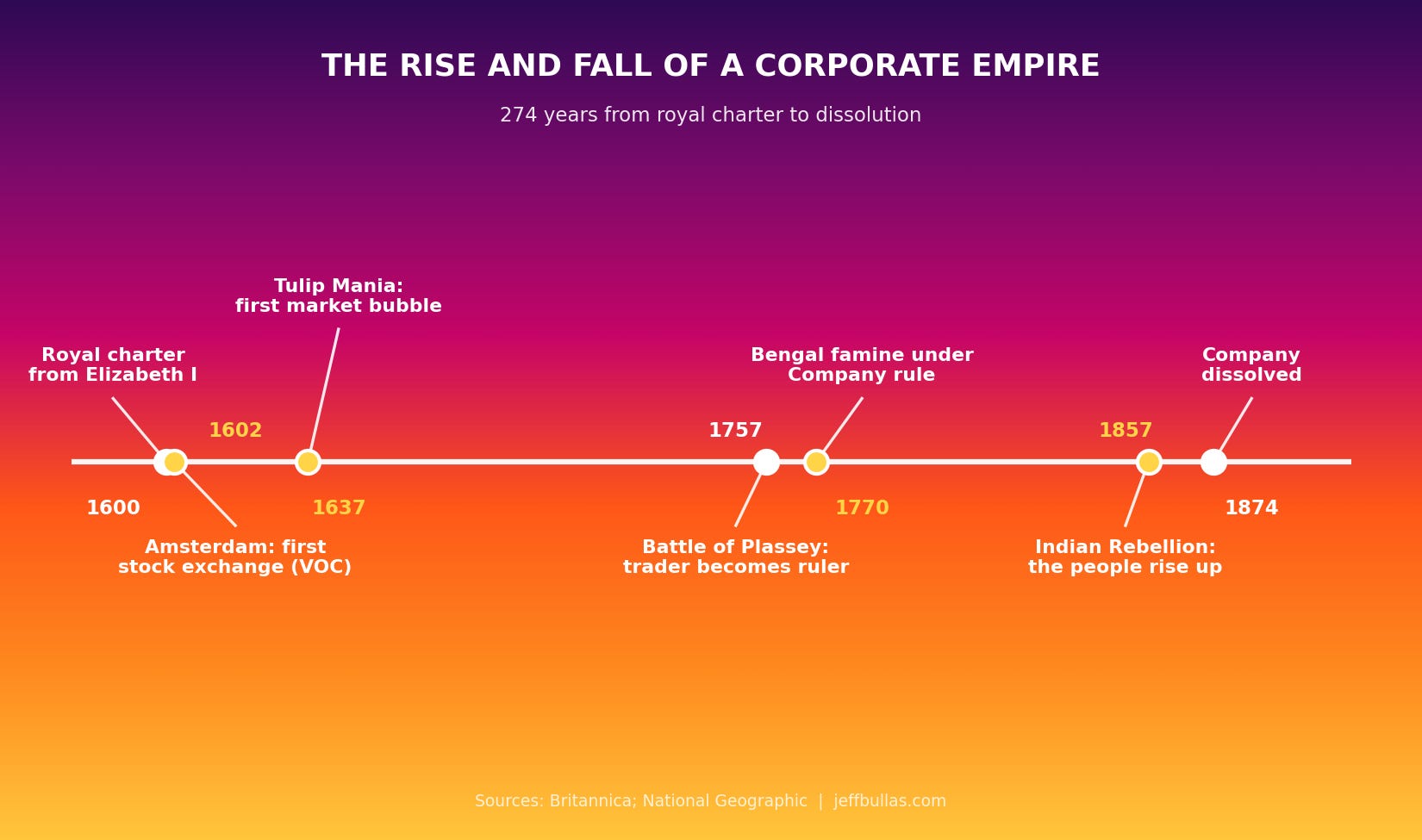
274 years from a piece of paper to a private empire to dissolution.
The pattern, not the company
Here is the mistake most people make with this story.
They think the villain was the East India Company. It wasn’t.
The villain was the pattern. And the pattern is simple:
A company gets a moat no one can cross. The moat creates wealth no one can match. The wealth buys power no one can check.
And then the company stops being a business and starts being a government.
A government with no citizens. Only customers.
A government with no constitution. Only quarterly earnings.
The East India Company didn’t set out to rule 200 million people. It set out to make money on pepper and tea.
The empire was a side effect.
The moat has changed. The pattern hasn’t.
In 1600, the moat was a royal charter and a fleet of ships.
In 2026, the moat is compute.
Chips. Data centers. Oceans of capital.
As of July 2026, Nvidia is worth around $4.7 trillion and last year it became the first company in history to touch $5 trillion. Apple and Alphabet sit above $4 trillion each. These are the first corporations to genuinely approach the old empires’ scale in real dollars, not inflated guilders.
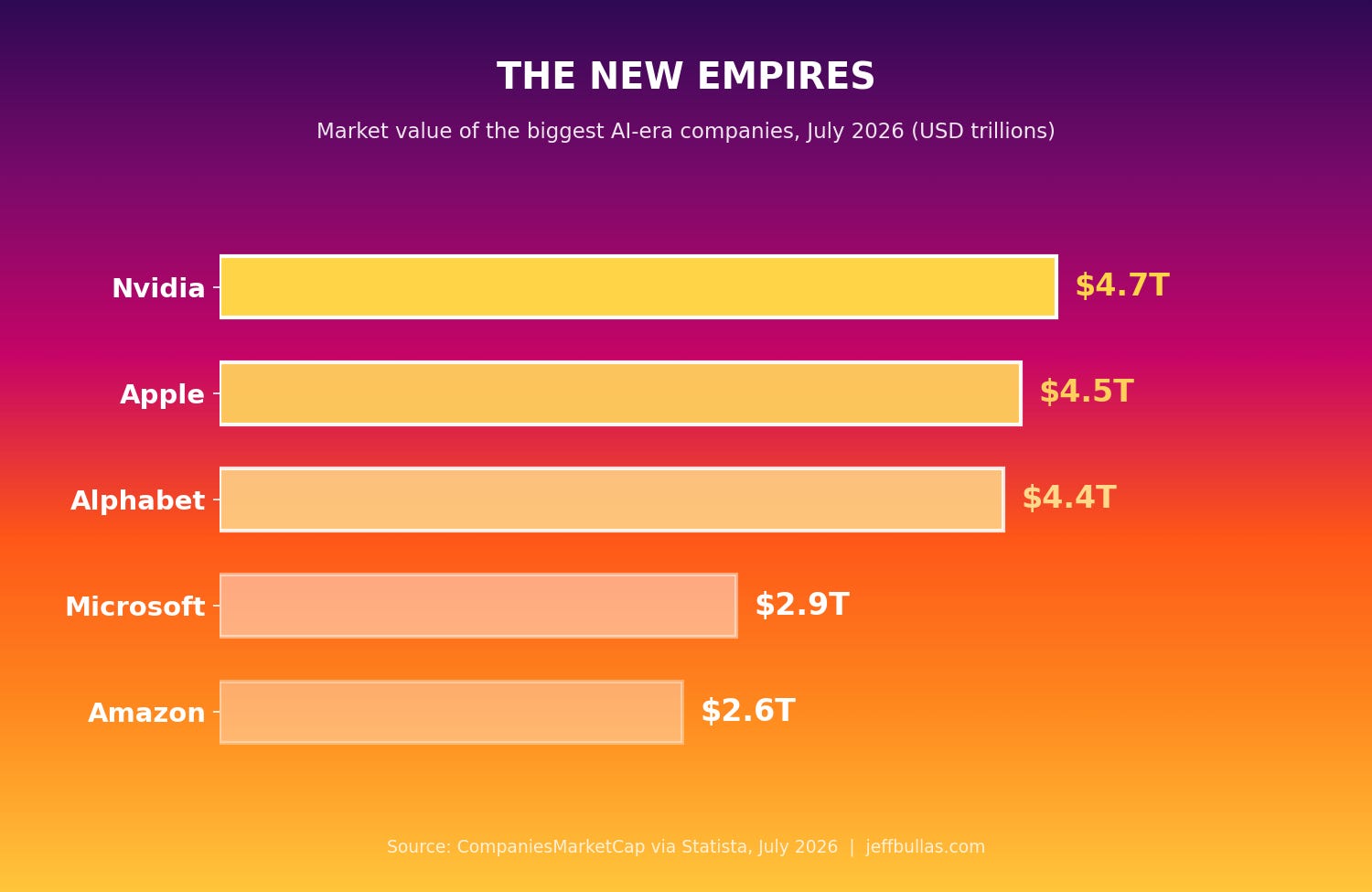
The new giants: market value of the biggest AI-era companies, July 2026.
The East India Company controlled the trade routes between Europe and Asia.
Today’s giants control the trade routes between a question and an answer.
Between you and what you know.
Between your attention and your own mind.
And they also control access to the distillation of the world’s intelligence.
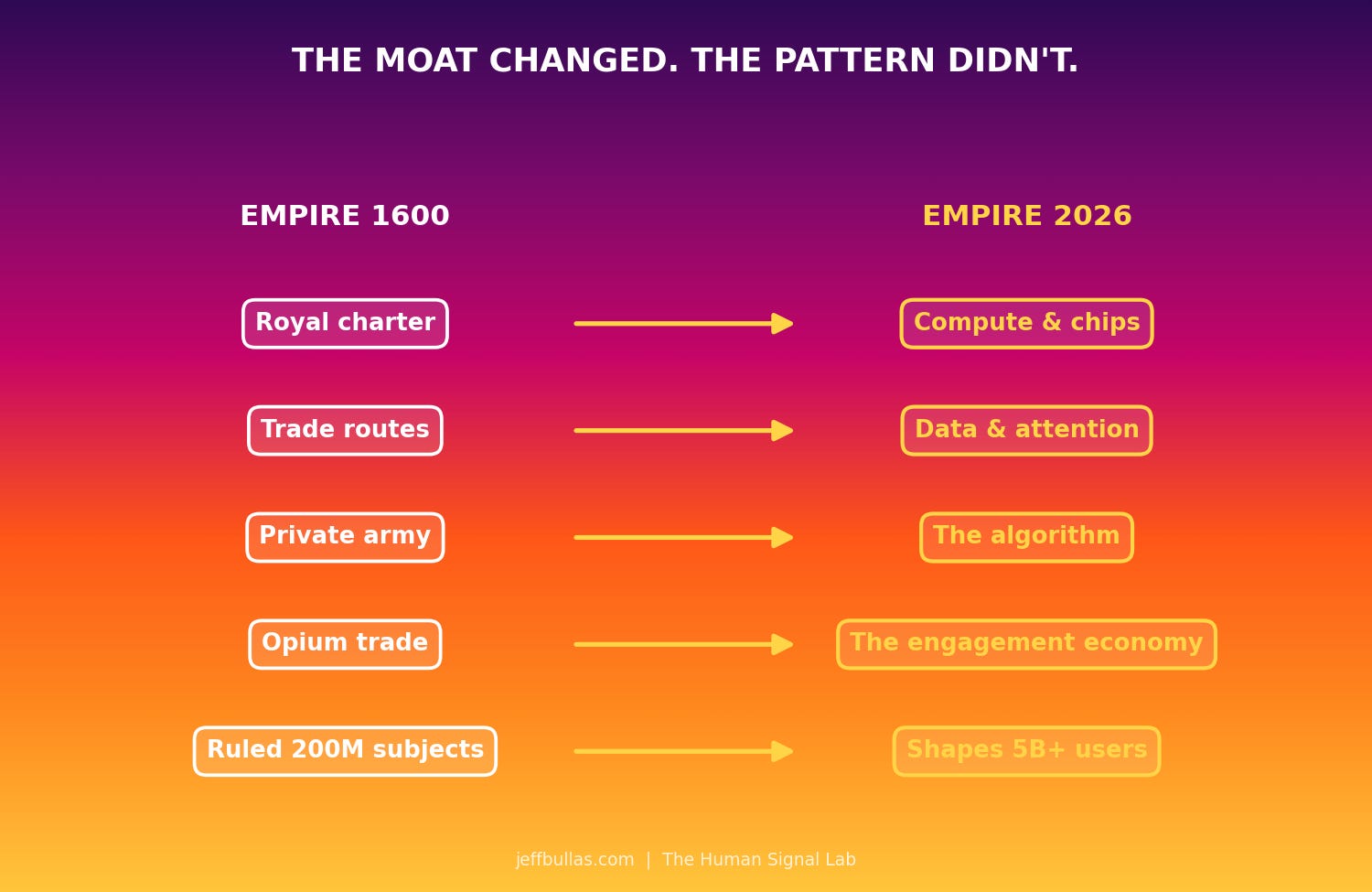
Different centuries. Same playbook.
The old company never asked India’s permission. The AI companies never asked for ours.
Nobody voted on whether an algorithm should decide what five billion people see each morning. Nobody signed a treaty handing over the world’s information supply.
It just happened. The way empires always happen.
One convenience at a time.
The opium chapter
In the 1800s, the East India Company needed to pay for the tea Britain was drinking. So it grew opium in India and sold it into China. Illegally. At scale.
A nation got addicted so a corporation could balance its books.
When China resisted, the wars that followed are named after the drug. The Opium Wars.
Now look at the last fifteen years.
The social media era ran the same play. The product was free. The addiction was the business model. Our attention was harvested and sold so the ad machine could balance its books.
I’m not being dramatic. I lived inside it. I built one of the world’s most-read marketing blogs on those platforms. Thirty-three million readers. I saw the machine from the inside, and for years I taught people how to feed it.
The empire doesn’t need your permission. It just needs your habit.
May 18, 2012: the day the music stopped
I can tell you the exact date the modern empire got its charter.
Facebook went public on 18 May 2012.
Before that day, Facebook was a company with users. After that day, it was a company with shareholders.
Those are not the same thing. Users want a good experience. Shareholders want a rising number, every ninety days, forever.
And the moment a company owes a rising number to a market, everything inside it starts bending toward that number. Not because anyone is evil. Because that is what the machine is now built to do.
Here is what bent.
In 2012, if you had a page with 10,000 followers, roughly 16% of them saw what you posted. Not perfect. But real. You built an audience and you could reach it.
By 2014 that number had fallen to 6.5%. By 2016 it was under 2%. Today many pages reach less than 1% of the people who chose to follow them.
Now look at what rose while that fell.
Facebook’s advertising revenue went from $1.97 billion in 2012 to $117 billion in 2022.
One line falls. One line rises.
Same platform. Same decade.
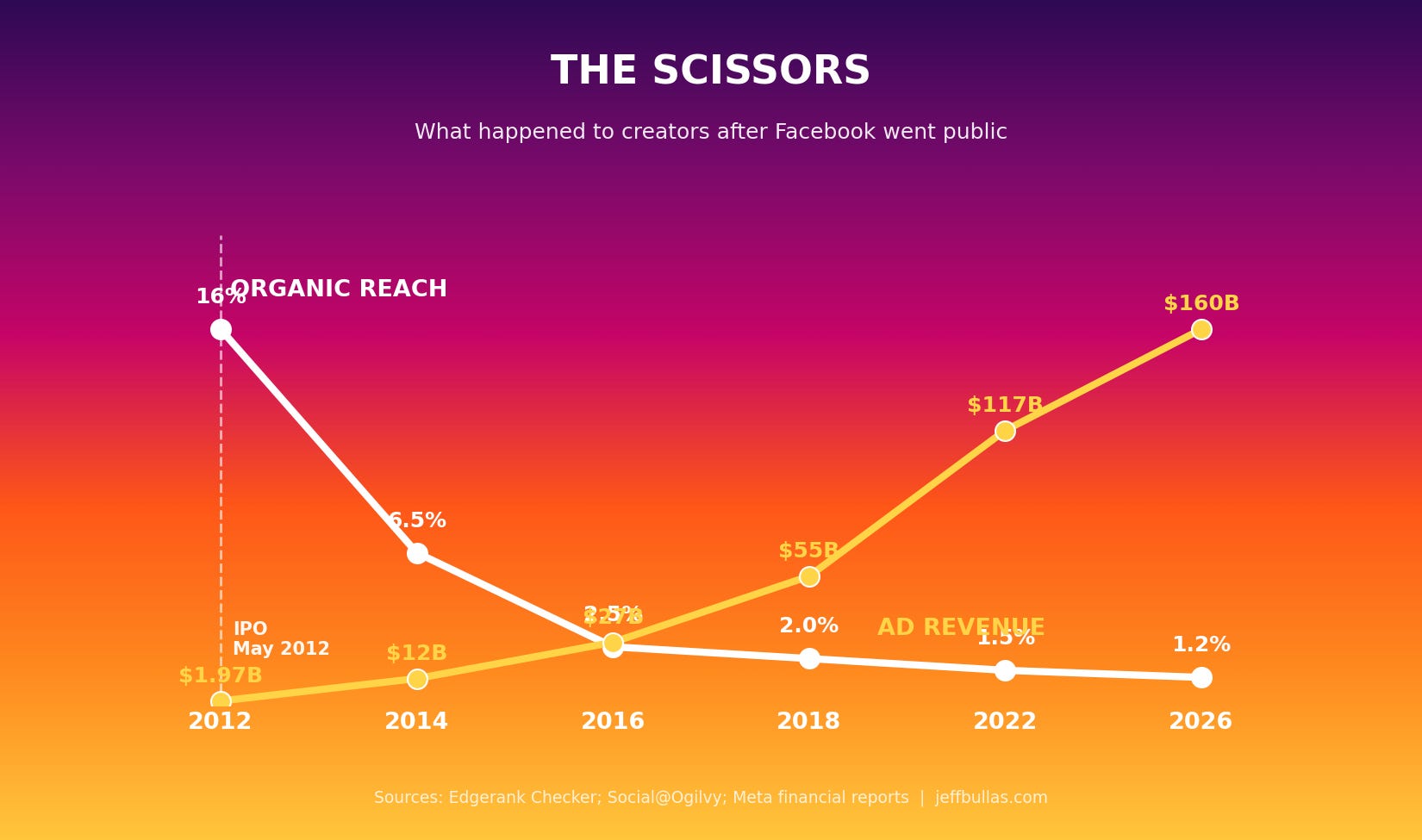
The scissors: organic reach collapses as advertising revenue climbs.
That is not a coincidence. That is a business model.
They didn’t take the audience away from us. They just started charging us rent to reach the audience we built.
You spent years making things people loved. Those people raised their hand and said: show me more. Then a company stepped between you and them, and put up a toll booth.
The audience was still there. The door was closed.
And the creators who had built the whole thing — the writers, the photographers, the small businesses, the people who filled the feed for free — were quietly moved from the front of the room to the back.
We weren’t the customers. We were the crop.
I remember the feeling. I’d wake up, look at the numbers, and something was wrong. Nothing had changed in my work. The words were the same. The effort was the same. The people were the same.
But the ground had moved underneath me.
I kept trying to write better posts, post at better times, crack the code. I thought it was me.
It wasn’t me. It was the charter.
A public company had been handed a new master, and the new master didn’t care about creators. It cared about the next quarter.
The East India Company’s shareholders sat in London and decided the fate of farmers in Bengal.
Facebook’s shareholders sat in New York and decided the fate of every creator on Earth.
Neither group ever met the people they were deciding for.
Facebook didn’t invent this. It inherited it. The tradable share, the quarterly demand, the distance between the owner and the consequence, all of it was built in Amsterdam four hundred years ago.
The IPO was the royal charter. The algorithm was the private army.
And we were the territory.
The Bengal lesson
In 1769, drought hit Bengal.
The East India Company was the ruler of Bengal by then. It had the stockpiles. It had the power to act.
It exported the food for profit instead.
Millions died while the company’s ships sailed out full.
This is what power without responsibility looks like. Ruling without governing. Extracting without owing anyone anything.
Limited liability limited the risk. Bengal is where it showed its shadow. Dividends in London. Graves in Bengal. And no one, anywhere, legally responsible.
The AI companies are now shaping work, truth, education, and creativity for the entire planet. They are governing, in every way that matters.
But who do they answer to?
Not citizens. They have none.
Only customers. And customers can’t vote. They can only click.
How empires end
The East India Company did not last forever. In 1857, the people it ruled rebelled. The British government finally stepped in, stripped the company of India, and by 1874 the most powerful corporation in human history was dissolved.
Gone. A luxury tea brand now owns the name.
The company that ruled 200 million people couldn’t survive the moment those people stopped cooperating.
Every empire built on extraction eventually meets its 1857.
I don’t know what form ours takes. Maybe regulation. Maybe rebellion. Maybe something quieter.
But I know where it starts. It starts with individuals refusing to be territory.
Here is what the farmers of Bengal never had: a choice about whose system they lived inside.
You have one. For now.
The empire’s business model depends on you renting everything. Rented reach. Rented audience. Rented tools. Rented answers.
The way out is ownership.
Own your audience. An email list is land the algorithm can’t tax.
Own your voice. Write things only you could write. Your stories, your scars, your point of view. The machine can copy your words but it can’t copy your life.
Own your thinking. Use AI as a tool, not a ruler. The moment it thinks for you, you’ve become territory.
Rome had a word for a person who was owned: a subject. And a word for a person who owned themselves: a citizen.
The East India Company turned citizens into subjects for 250 years.
In the age of AI, which one are you going to be?
The company that owned the world is gone. The pattern that built it is alive and hiring.
Don’t be territory. Be sovereign.
Sources and further reading
How the East India Company Became the World’s Most Powerful Monopoly — History.com
How the East India Company became the world’s most powerful business — National Geographic
5 Fast Facts About the East India Company — Britannica
Armies of the East India Company — National Army Museum (UK)
East India Company — Wikipedia
The Legacy of the Dutch East India Company — Foster Moore
Was the VOC the most valuable company ever? — The World’s First Stock Exchange (Lodewijk Petram)
Which company was the most valuable in history? — ReadWriteInvest
History’s Biggest Companies vs. The Magnificent Seven — Visual Capitalist
Leading tech companies by market capitalization, July 2026 — Statista
East India Company: The curtain falls — TRT World
The Decline of Organic Facebook Reach — HubSpot